Article Contributed by Gratefulweb
Published on 2025-12-13
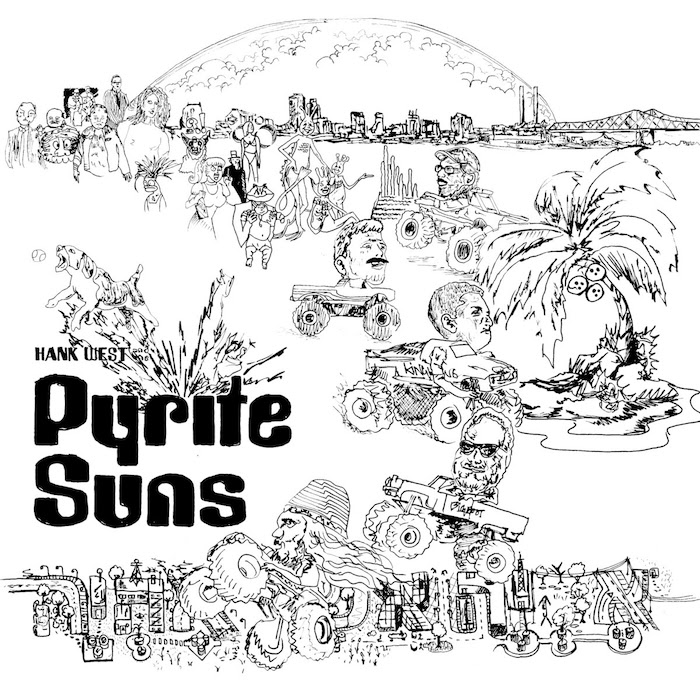
Squirrel Nut Zippers’ longtime saxophonist Hank West has released his new album, Hank West and the Pyrite Suns, his third solo project and the first with his newly formed ensemble, the Pyrite Suns. Influenced in part by Alvin Toffler’s Future Shock, the record satirizes today’s digital absurdities while blending jazz, soul, prog, and alt-R&B into a sound Earmilk calls “an innovative, one-of-a-kind listen,” with Heatwave praising it as “musically stunning.”
The album glows with a retro-futurist sheen—like transmissions from a parallel-universe New Orleans where brass sections swirl through modular synths. It’s playful, cosmic, and unmistakably human.
A singer, songwriter, composer, and multi-instrumentalist, West is best known for two decades of wild, brass-driven touring with Squirrel Nut Zippers, who broke through with the MTV hit “Hell” in 1997. Now he steps further into his own vision, driven by what he calls “the organic method”—arriving at the studio with ingredients, not blueprints, and letting the music reveal itself.
Some songs on Pyrite Suns were written on the spot; others simmered for nearly a decade before finding the right band. The Pyrite Suns—Chris “Pizzaman” Sennac (bass), Nielson Bernard III (drums), Leslie Martin (piano), Brent Rose (flute/sax), and Shabbo Cahmimb (synths)—join West on vocals, trumpet, sax, and tuba to create a sound that is both tactile and space-age.
The first single, “Pyrite Suns,” is a jagged, humorous fusion of Zappa-esque prog, jazz, and alternative R&B. West describes it as a rooftop hang gone sideways—one chilled-out observer watching another loudly proclaim himself a god. The title nods to pyrite crystals that form with only one polished side, mirroring the song’s ego-tripping protagonist.
Throughout the album, West circles themes of recursion and miscommunication—a concept that crystallized when he was challenged to distill his sprawling ideas into one motif: circles. Spiral basslines, looping lyrics, and swirling arrangements all reflect the fractured ways we try (and fail) to connect in a digital world.
Recorded at Marigny Studios near New Orleans’ Bywater district with engineer Rick Nelson, the album moves from moody instrumental pieces (“Instant Intimacy,” “Kleptocracy”)—which West likens to being on the empty set of Welcome Back, Kotter—to alt-R&B-leaning vocal tracks (“The Spots I See,” “Up and Down”) exploring glitches, mixed signals, and the comedy of online life.
West draws loose inspiration from Future Shock and its Orson Welles-narrated film adaptation, reimagining digital anxiety as absurdist theater: stories of people breaking into your house after finding your address online, flat-Earth believers, and polygonal aliens. “I don’t believe everything I write about,” he says. “I’m an artist—I make art out of other people’s beliefs.”
Musically, the lineage stretches from Raymond Scott to Kurt Weill, with nods to Herb Alpert, Sinatra, D’Angelo, and the warm imperfections of early synth-jazz explorations. West calls it “a synergy between Moog synthesizers and the jazz vernacular.”
Born in South Carolina’s Congaree Swamp and raised in the Appalachians, West wandered through 1920s hot jazz, second-line brass, and ’90s techno before joining the Zippers in 2007, leaping immediately into international touring. Between tours, he crafted side projects with a deliberately loose, exploratory approach.
Hank West and the Pyrite Suns is his most focused solo statement yet—an adventurous blend of humor, futurism, and groove.
Even with its conceptual architecture, West avoids clean resolutions. He prefers creative environments with constraints, detours, and surprises. “When you make something difficult for yourself, you find weird, roundabout paths,” he says. “And along the way, you discover a lot more about what you’re trying to say.”