Article Contributed by Gratefulweb
Published on 2026-10-06
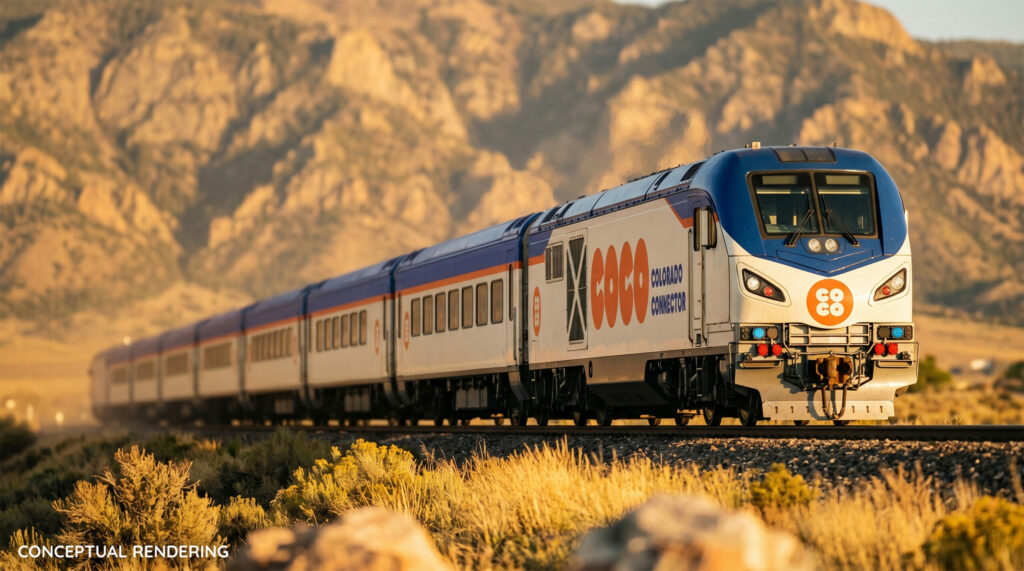
Conceptual rendering of the Colorado Connector passenger train. Courtesy of the Front Range Passenger Rail District.
Colorado has talked about Front Range passenger rail for decades. Ballot Issue 7A gives voters an opportunity to stop talking and begin building the connected transportation system our growing state needs.
Grateful Web encourages voters within the Front Range Passenger Rail District to vote yes on 7A and support the Colorado Connector.
The Colorado Connector, also known as CoCo, is a proposed intercity passenger train linking 12 Front Range communities: Fort Collins, Loveland, Longmont, Boulder, Louisville, Broomfield, Westminster, Denver, Littleton, Sterling Ranch, Colorado Springs and Pueblo. The project would use mostly existing rail corridors, with Denver Union Station serving as the center of the system.
Issue 7A would establish a 0.333% sales and use tax within the district—one-third of a cent on a $1 purchase—to construct, operate and maintain the system. Gasoline, food, residential electricity and gas, prescription drugs and medical supplies would be exempt.
The measure would provide the funding necessary to extend passenger service south from Denver through Colorado Springs to Pueblo, increase the frequency of trains throughout the corridor, improve station areas and local connections, and support a new Amtrak station in Trinidad.
Starter service between Denver and Fort Collins is already expected to begin in 2029 with three daily round trips. A yes vote would help bring service south to Pueblo, currently proposed for 2032, and eventually increase service to as many as 10 daily round trips on the northern route and eight on the southern route.
That distinction matters. Voting yes is not simply supporting an abstract promise of someday having a train. It means completing the larger Front Range connection and giving the system enough service to become a useful transportation option rather than an occasional novelty.
Anyone who has spent time crawling along Interstate 25 understands why Colorado needs another choice. Our population continues to grow, highway congestion keeps getting worse and endlessly adding traffic lanes will not solve the problem by itself. Passenger rail will not eliminate traffic, but it can remove vehicles from the highway while giving residents and visitors a safer and less stressful alternative to driving.
The Colorado Connector could make it easier to reach jobs, colleges, concerts, sporting events and cultural destinations without spending hours behind the wheel. For music fans, it could eventually mean traveling between communities along the Front Range without worrying about traffic, parking or the drive home after a show.
There is also an environmental reason to support the measure. Transportation remains a major source of Colorado’s air pollution and greenhouse gas emissions. A functioning passenger rail system offers residents a practical way to reduce vehicle miles without asking them to stop traveling between the communities where they live, work and gather.
The tax deserves to be considered honestly. It would generate an estimated $295 million annually, and consumers within the district would pay slightly more on taxable purchases. Large public transportation projects are expensive, and voters are right to expect transparency, responsible management and meaningful oversight.
Issue 7A includes annual reviews by an independent auditor and a rotating group of taxpayers who live within the district. That oversight must remain serious throughout the planning, construction and operation of the system. Colorado should demand that the project meet its commitments, control costs and clearly communicate its progress.
But refusing to invest carries costs, too. Congestion wastes time and fuel. Highway expansion costs billions of dollars. Crashes take lives. Air pollution damages public health. Continuing to rely almost entirely on cars will not become less expensive as millions more people make their homes along the Front Range.
Colorado should be building transportation for the next generation, not forcing it to depend on infrastructure designed around the last one.
Passenger rail is not a radical idea. It is a familiar and effective part of transportation systems across the country and around the world. Colorado has the population, the travel demand and much of the existing rail infrastructure needed to make it work. What has been missing is the sustained public commitment to move forward.
Issue 7A gives Front Range voters the chance to make that commitment.
Vote yes on 7A. Let’s connect Colorado, give people an alternative to I-25 and finally put Front Range passenger rail on track.