Article Contributed by Mike
Published on 2026-10-29
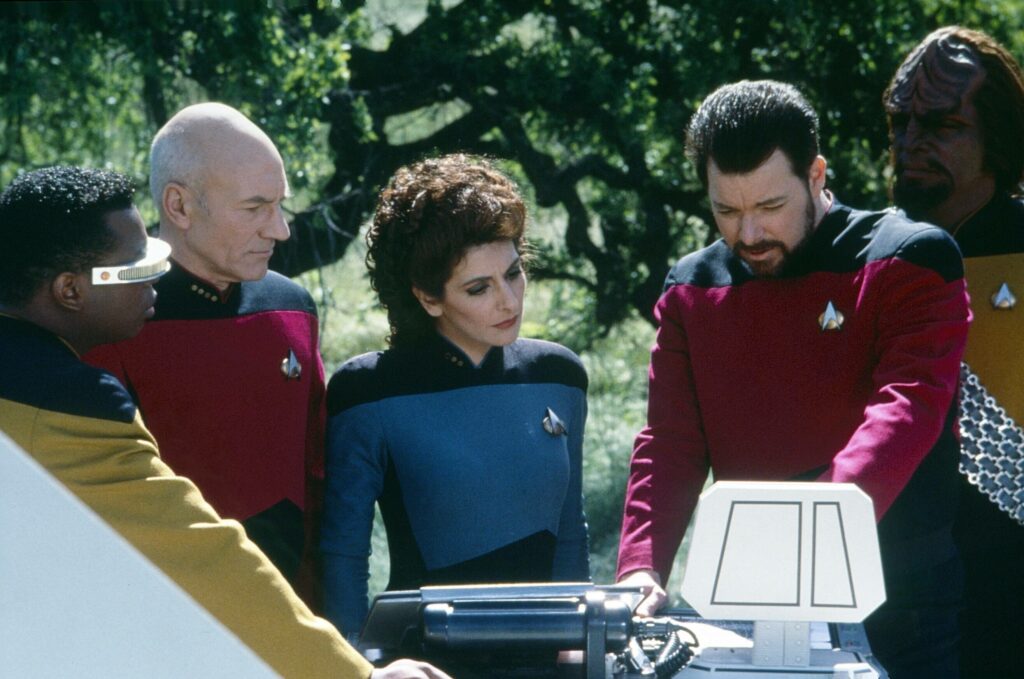
Patrick Stewart as Captain Jean-Luc Picard alongside LeVar Burton, Marina Sirtis, Jonathan Frakes, and Michael Dorn in Star Trek: The Next Generation (1987–1994). Photo: Paramount Television / Everett Collection.
Sir Patrick Stewart, the celebrated British actor who gave the world Captain Jean-Luc Picard in Star Trek: The Next Generation, has died at the age of 86. His death was announced on October 29, 2026. For generations of fans, Stewart was far more than an accomplished actor. He was the steady voice of reason on the bridge of the Enterprise, a man who reminded us that curiosity, compassion, intelligence and the courage to do what is right are among humanity's greatest strengths.
Here at Grateful Web, his passing feels personal.
During my college years, Star Trek: The Next Generation was something my fellow Deadheads and I looked forward to watching every day. We loved the Grateful Dead, the community, the adventure and the possibilities that seemed to exist beyond the conventional world. And in a very different way, The Next Generation spoke to many of those same feelings.
There was something about Picard and his crew that resonated with us. Here was a group of people traveling through the universe, encountering strange civilizations, asking difficult questions and attempting to understand worlds very different from their own. They didn't always have the answers. They made mistakes. But they kept exploring, learning and trying to become better versions of themselves.
For a bunch of Deadheads in college, that was pretty appealing.
Stewart portrayed Captain Jean-Luc Picard throughout all seven seasons of Star Trek: The Next Generation, which aired from 1987 to 1994. His performance helped transform a character who could have been little more than a commanding authority figure into one of television's most thoughtful and deeply human leaders.
Picard wasn't Captain Kirk. He wasn't interested in charging into every confrontation with his fists. He valued diplomacy, knowledge, history, music and the extraordinary diversity of the universe. He believed that communication was often more powerful than force and that understanding another civilization was worth the effort, even when that understanding came at a tremendous personal cost.
Few episodes captured that philosophy more beautifully than “The Inner Light.”
A Lifetime in 25 Minutes: Remembering “The Inner Light”
Originally broadcast on June 1, 1992, during the show's fifth season, “The Inner Light” remains one of the most extraordinary episodes of television I've ever experienced.
In the episode, the Enterprise encounters a mysterious probe that renders Picard unconscious. But instead of simply losing consciousness, he awakens on an unfamiliar planet called Kataan, where the people around him insist that he is a man named Kamin.
What follows is something remarkable.
Picard lives an entire lifetime.
He falls in love, builds a family, raises children, grows old and experiences the ordinary joys and heartbreaks that define a human life. As the years pass, he comes to understand that the civilization around him is dying. Its people know their world cannot survive, and they have devised an extraordinary way to ensure that someone, somewhere, will remember that they existed.
They send their memories into the stars.
When Picard finally awakens aboard the Enterprise, only about 25 minutes have passed. But for him, decades have gone by. He has lived another life, loved another family and witnessed the disappearance of an entire civilization.
And then comes that unforgettable final scene.
The crew retrieves a small box from the probe. Inside is the flute Picard learned to play during his life as Kamin. Alone in his quarters, he holds the instrument and begins to play.
It's a devastatingly beautiful moment, and Stewart delivers it with extraordinary restraint. He doesn't need a grand speech or some dramatic display of emotion. The expression on his face, the silence around him and the fragile sound of the flute tell us everything.
That episode has stayed with me for more than three decades.
What makes “The Inner Light” so powerful isn't the science fiction technology or the mystery of the probe. It's the idea that a civilization can disappear, but its stories, music, love and memories can somehow survive.
And isn't that, in some ways, what music does too?
A song can outlive the person who wrote it. A performance can remain with someone for decades. A melody can carry us back to a particular place, a particular group of friends or a moment in our lives that we thought was long gone.
That's something Grateful Dead fans understand particularly well.
From Excalibur to the Enterprise
Long before he became Captain Picard, Patrick Stewart was an accomplished stage actor with deep roots in classical theater. His commanding voice and remarkable ability to convey complicated emotions made him a natural fit for Shakespeare, but those gifts also translated beautifully to film.
One of my favorite early appearances was in John Boorman's 1981 fantasy epic Excalibur, a visually stunning interpretation of the Arthurian legend. Stewart played Leondegrance, bringing the same sense of dignity and gravitas that would later become inseparable from Jean-Luc Picard.
Excalibur was an unforgettable film, filled with mythology, extraordinary imagery and larger-than-life characters. Looking back, it's easy to appreciate how much Stewart could communicate simply through his presence.
He would go on to reach another generation of audiences as Professor Charles Xavier in the X-Men films, portraying another thoughtful leader who believed that people with extraordinary differences could find ways to live together.
But for me, and I suspect for countless others, he will always be Picard.
Boldly Going, Together
There was something comforting about returning to the Enterprise during those college years. No matter what was happening in the world, there was always another strange planet, another moral dilemma and another opportunity to see what this remarkable crew would encounter next.
And Stewart was the heart of it.
He could be stern, funny, vulnerable, stubborn and compassionate. He understood that leadership wasn't about always being right. It was about accepting responsibility, listening to others and having the courage to change your mind.
When I think about the Grateful Dead community and those years of watching The Next Generation, I think about how much both experiences encouraged us to see the world differently. The music took us places we never imagined going. Star Trek encouraged us to imagine places we hadn't yet discovered.
Both reminded us that there was always more to explore.
Patrick Stewart leaves behind an extraordinary career across theater, film and television. But his greatest achievement may be the countless people he inspired through a fictional starship captain who believed in the possibilities of humanity.
And I keep coming back to “The Inner Light,” to that little flute and the civilization that refused to be forgotten.
Maybe that's the perfect way to remember him.
Patrick Stewart spent a lifetime telling stories. Through those stories, he made us laugh, think, question ourselves and occasionally shed a few tears. And now, like the people of Kataan, something of him will travel onward through the memories of everyone his work touched.
Thank you, Captain.
We'll keep exploring.
— Grateful Web