Article Contributed by Champagne House Media
Published on 2026-08-17
Picture yourself as a dot in a vast mountain range.
Early in the morning, you ascend a ridgeline as a thick bank of fog sweeps over the adjacent mountainside, fills the canyon below, and begins to overtake you. As you reach the peak, a second bank of fog rises to meet the first, creating a double updraft on both sides of the ridge, engulfing you in dense, whirling clouds. You feel sublimated, insignificant, and unafraid. A guardian watches over you.
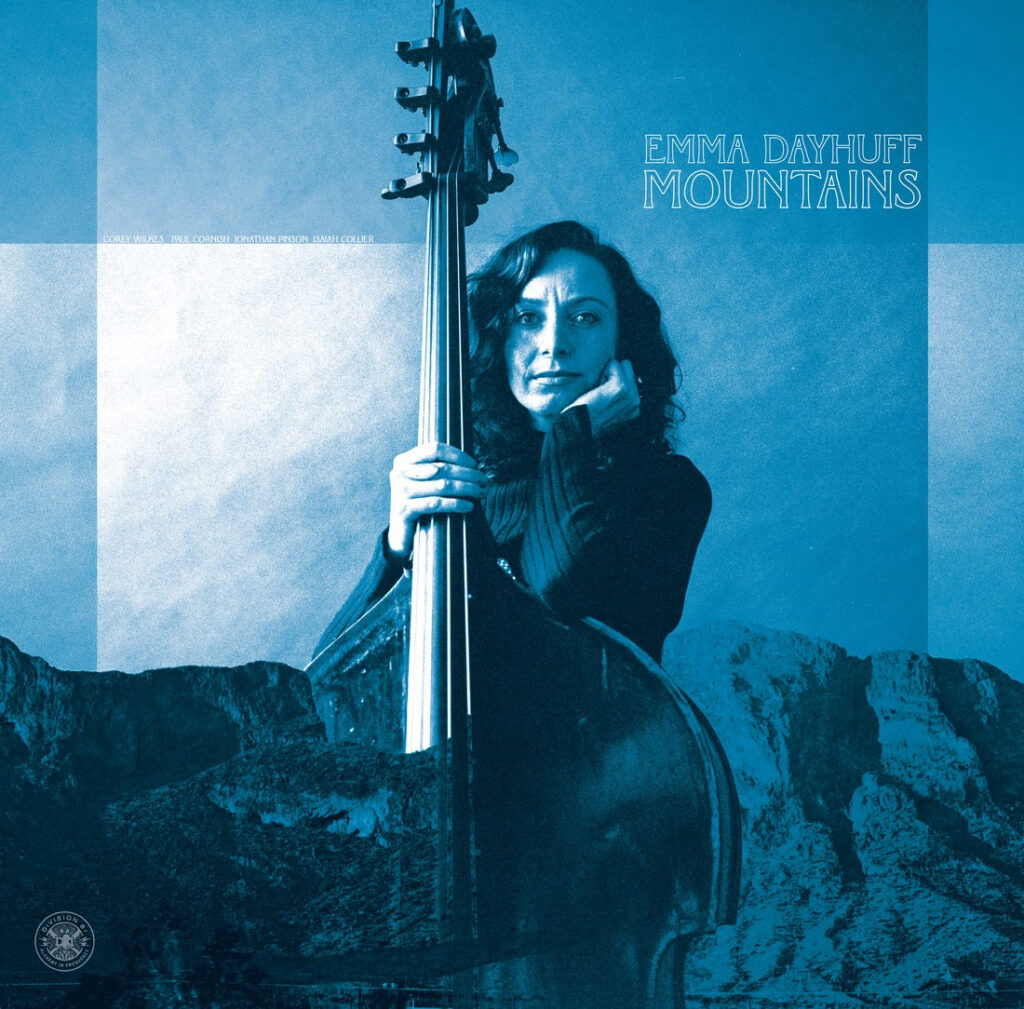
This is what bassist, composer and bandleader Emma Dayhuff conjures in the first minutes of Mountains, her forthcoming second album as a leader. The music charts a path back to her childhood in Bozeman, Montana, where she was raised amid the jaw-dropping vistas that would eventually find their way into her compositions.
The album's first single, “The River,” introduces the idea through a composition Dayhuff wrote to push the boundaries of collective musical phrasing.
“But like a river is hemmed in by its banks, the rhythmic boundaries are defined,” Dayhuff explains. “As the water gains momentum, it becomes increasingly difficult to stay within those boundaries without a certain amount of chaos becoming part of the journey.”
Dayhuff started music at nine years old on Irish fiddle, switched to bass in public school and studied at the Oberlin Conservatory before moving to Chicago, where she immersed herself in the city's creative music community. In 2016, she moved to New York to play in clubs each night until 4 a.m. — a life that felt about as far from Bozeman as one could possibly be.
One night on the banks of the Hudson River, her worlds collided.
“Looking out over the river, I felt the same sense of kinship with the New York City skyline as I did with the mountain ranges surrounding my childhood home,” she recalls. “The world suddenly felt smaller, less intimidating.”
Mountains grew from Dayhuff's 2025 debut album, Innovations & Lineage: The Chicago Project, which featured saxophonist Isaiah Collier, vocalist Dee Alexander and percussionist Kahil El’Zabar.
“The first record was an homage to the Chicago style of groove-based avant-garde playing,” she explains. “This record takes that concept of composition and mixes it with a Los Angeles approach to modern jazz, pulling from R&B, hip-hop, funk, and rock.”
The band itself reflects those two musical worlds, pairing Chicagoans Corey Wilkes and Isaiah Collier with Angelenos Paul Cornish and Jonathan Pinson.
Trumpeter Corey Wilkes was one of the first people Dayhuff met in Chicago. With great fanfare, he walked through the door to a jam session with trumpeter Maurice Brown at the New Apartment Lounge on the South Side at two in the morning.
“They brought this insanely infectious energy — I had never experienced anything like it,” Dayhuff remarks.
She has known Collier for a decade. “We were both figuring out how to play at the same time, and we found our way to the same mentor in Vincent Davis.”
Dayhuff and Cornish attended the Herbie Hancock Institute of Jazz Performance together, of which Pinson is also an alum. “Playing with Paul and Jon is truly the best,” she says. “They both manage to be definitive and flexible at the same time, and they do it together, which is a rare gift.”
Beginning with “Capricorn,” Mountains descends from the top of the mountain, following the ways the mind wanders between being present in nature and reflecting on life.
“It always surprises me how loud the most gentle breeze can be in the mountains,” Dayhuff says. “You hear it from miles away as it funnels through the trees and canyons. At first, the sound is unnerving — like an approaching storm. But it becomes familiar, comforting.”
That landscape is constantly changing. “Scorched Bark and Wildflowers” was originally called “Fire,” until Dayhuff realized fire told only part of the story. What stayed with her was the forest's recovery: “the explosion of flowers and young trees that take over a mountainside alongside the blackened skeletons of former giants.”
Elsewhere, the scenery gives way to relationships and memory. “Distance” is what Dayhuff calls “a complex love song,” exploring the physical and emotional longings that accompany mercurial long-distance relationships.
On “Horsefeathers,” she reaches further back. “I grew up an only child in an old farmhouse on a dead-end trailhead. The horses were my main companions when I got home from school,” Dayhuff relates.
The song evokes the rhythmic agility of riding horses and the playfulness of childhood — two qualities she also recognizes in the way musicians interact on the bandstand.
The only song on Mountains not written by Dayhuff is “Jesus Is A Lonely Man,” by bassist and legendary composer Bill Lee. Originally written for Richard Davis and the New York Bass Choir, the piece carries a personal connection for Dayhuff.
“I got to know Richard a little during the last years of his life, and once I learned this song, it stuck with me.”
After the Parliament-inspired “Valleys Above,” the ruminative “Skylines” closes the album back on the shores of the Hudson, where the skyscrapers once reminded Dayhuff of the mountains surrounding her childhood home.
“Life is mountains and valleys, you know?” she says. “These are the moments that define who we are.”
Across Mountains, those moments stretch from Montana to Chicago, New York and Los Angeles; from childhood trails and horses to 2 a.m. jam sessions and the Hudson River. Dayhuff finds connections between places that once seemed impossibly far apart and between the musicians and experiences that shaped her along the way.
With Mountains, she has charted that terrain like never before. Look out below.
Track Listing
1. Sentinel
2. Capricorn
3. The Wind
4. Scorched Bark & Wildflowers
5. Distance Featuring Akenya Seymour and Andrew Renfroe
6. The River
7. Horsefeathers (Hey Paul)
8. Jesus Is A Lonely Man
9. Valleys Above
10. Skylines