Article Contributed by Gratefulweb
Published on 2026-08-15
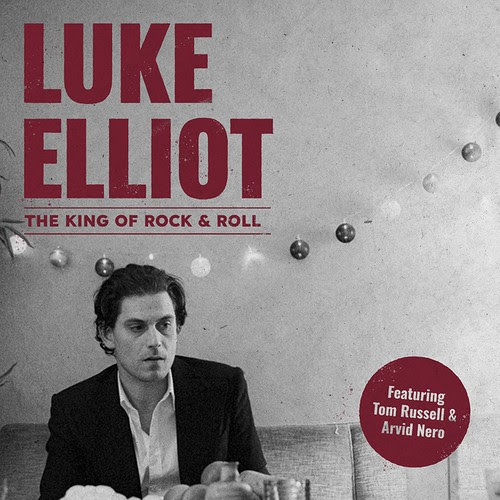
Luke Elliot explores inspiration, mythology and transformation on new single “The King of Rock and Roll,” featuring legendary American songwriter Tom Russell and Swedish troubadour Arvid Nero. The single will be released September 4 on Icons Creating Evil Art, with a new album coming this winter.
The word “inspiration” comes from the Latin inspirare. It literally means: “to breathe into.”
Originally, inspiration was not understood as having a good idea. It was considered something almost physical, spiritual and force entering a person from somewhere outside themselves. The artist was not viewed as a manufacturer of content, but as a receiver. A translator. Someone briefly inhabited by meaning. This became one of the starting points for Luke Elliot’s new album, The King of Rock and Roll.
The album, and particularly its title track, began as a questionable conversation between two musicians meeting up for a coffee. Elliot and songwriter Frode Jacobsen (Madrugada) found themselves in one of those half-serious conversations. The subject was songwriting itself. Whether songs emerge from imagination, instinct, obsession, discipline, divine madness, or simply from refusing to get a proper job. A type of conversation that quickly bites its own tale.
But at some point, the conversation drifted toward the word music itself. The word derived from the Ancient Greek mousikē — “the art of the Muses.” In Ancient Greece, music was not separated from poetry, memory, storytelling, rhythm, mythology, or emotion. It was considered something sacred. Some thought it was a force capable of shaping the soul of a civilization.
Which eventually led them to Elvis – the force who have shaped their civilization and who had been and still is an inspiration for both of them, and of course many more. The conversation was not about Elvis the monument. Not the rhinestone mythology sold beside airport postcards and coffee mugs. But Elvis before the mythology: the unknown boy standing somewhere between poverty and possibility, trying to turn confusion into sound before anyone had informed him it was impossible.
The discussions quickly became less about celebrity and more about transformation itself. What invisible force drives a human being toward becoming “The King of Rock and Roll”? Vanity? Loneliness? Fear? Beauty? Ambition? Delusion? Hunger? Probably all of it.
What interested Luke, was the moment before mythology hardens into commerce. Before the performance becomes institutionalized. Before the artist disappears beneath interpretation.
Because at that stage, the artist is still visible.
Still uncertain. Still improvising. Still trying and failing trying in front of an audience.
That became the emotional center of the song and later of the record.
“The song isn't really about Elvis,” says Luke Elliot. “It's about the moment before mythology takes over. Before the artist becomes an institution. Before certainty. That fragile space where you're still searching, still failing, still trying to turn confusion into something meaningful.”
As the song developed with the additional help of Luke’s longtime producer/collaborator, Freddy Holm, one name kept resurfacing.
“Tom Russell has always represented a kind of artistic fearlessness that I deeply admire,” Elliot explains. “He's one of those rare songwriters whose work has travelled through generations and found its way into the hands of legends. Having him lend his voice to this song felt almost surreal. He understood immediately what we were reaching for, and somehow brought even more humanity to it.”
Few contemporary songwriters command the respect Russell enjoys. Often described as one of America's greatest living songwriters, his catalogue has been recorded by artists including Johnny Cash, Doug Sahm, Nanci Griffith, k.d. lang, Ramblin' Jack Elliott, Iris DeMent and Joe Ely. Across a career spanning more than four decades, Russell has established himself as a singular voice in American folk, country and Americana.
Another unexpected piece fell into place when Luke crossed paths with Arvid Nero.
“I met Arvid sometime during the process and played him the song,” Luke recalls. “He immediately connected with it. Not from a commercial perspective or because there was anything to gain from it — he simply loved the song. A few weeks later he was standing in the studio singing harmonies. It felt completely natural. His voice added something beautiful and human that the track really needed.”
Built around the philosophy that inspiration is something to be followed rather than controlled, “The King of Rock and Roll” became one of the fastest songs Luke Elliot has ever recorded. What began as a conversation evolved into a spontaneous studio session that seemed to take shape almost on its own. Then they added collaborators like Bebe Risenfors (Tom Waits, Elvis Costello), Lise Sørensen's strings and background vocals, and of course Tom Russell and Arvid Nero.
The result is a song that looks beyond celebrity and mythology, searching instead for the spark that exists before recognition, before interpretation and before commerce.
The moment where creation begins.
The moment where possibility still exists.
The moment before everything hardens into legend.
With “The King of Rock and Roll,” Luke Elliot invites listeners back to that place.
Luke Elliot on Tour
September 12th — Södra Teatern — Stockholm (with full band)
September 19th — Cafe 1851 — Malmö
October 3rd — Katalin — Uppsala
October 16th — Pustervik — Göteborg (with full band)
December 4th — Kampen Kirke — Oslo (with full band)
More dates TBA.
Tickets and more info: https://www.lukeelliot.com/shows