Article Contributed by Sam A. Marshall
Published on December 16, 2025
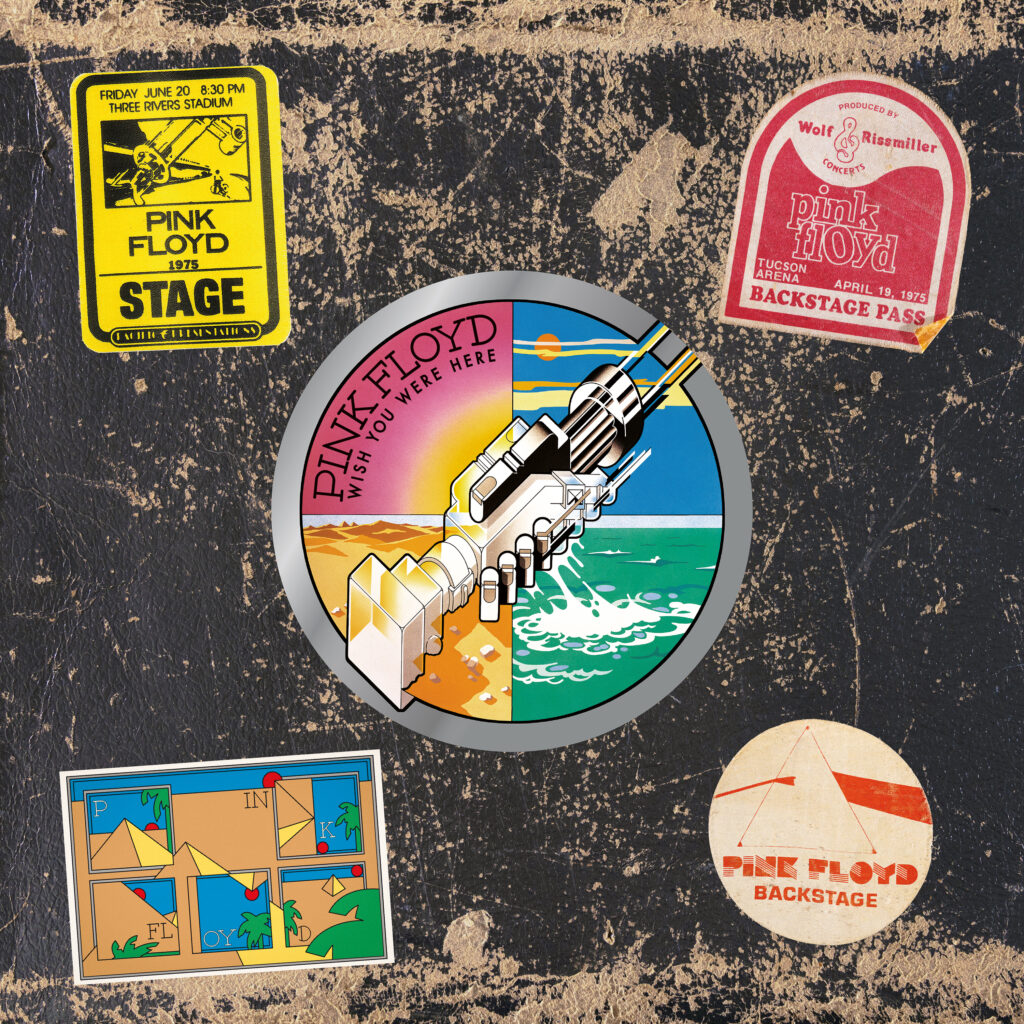
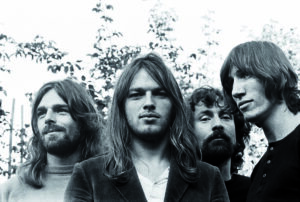
As luck would have it for one of the luckiest bands ever to have come out of the late-1960s explosion of cutting-edge experimental rock, those Masters of Time and Space better known as Pink Floyd sailed high on the steel breeze in what was arguably their most fertile and productive period between 1969 and 1975.
This means, of course, that all of the Floyd albums from that period have now hit the 50-year milestone. And the latest PF album to have reached its Golden Anniversary – this past September 12th – is the ever-tantalizing and mind-twisting conceptual PF masterpiece, Wish You Were Here. And there’s a big celebration now in progress!
If you count yourself among the inner circle of the most devoted Floyd fans, then – like that lucky old band – count yourself extra lucky. As of Dec. 12 – thanks to Sony Music Entertainment – there’s now a new reissue of that classic Floyd album in multiple formats to celebrate WYWH’s 50th anniversary. And depending on the format you’d opt for, you’ll find most of them jam-packed with lots of extra Floydian goodness, all right!
Where to start? Well, hey, there’s the previously remastered stereo mix of the original album plus a nice cross-section of archival material, which includes both previously released and recently unearthed recordings. Among these nine bonus tracks – six previously unreleased! – are several working versions of the title track, plus a longer, jammier alt version of “Have a Cigar”, two demo versions of “Welcome to the Machine” (as “The Machine Song”, versions #1 & #2) and an early studio capture of “Shine on You Crazy Diamond”. All of these working versions shed new light on the notoriously secretive band’s studio explorations while they were struggling with the creation of their eighth studio album.
But even more: For the first time, thanks to longtime PF producer James Guthrie, there’s also a newly-remixed and joined stereo version of “Shine on You Crazy Diamond”. This links together the Parts I-V of the album’s first half with Part VI-IX, as the Floyd intended when they first wrote and performed it live in 1974. And, in terms of a superb treasure for the most serious fans, various versions of the reissue (vinyl, Blu-Ray and digital download versions) include a complete 1975 live performance from the Los Angeles Sports Arena that preceded the album’s release by five months.
New PF material at the time – which included some WYWH tracks still being refined before the album was finalized – was included in the first set on that tour. (“SoYCD” and “Have a Cigar”) In addition, of course, as a standard part of that tour, there was a full performance of “Dark Side of the Moon” in the second set and a stunning encore performance – with added saxophone and backing vocals! – of the deeply psychedelic PF mind voyage, “Echoes”. So these other historical items are included as well.
As you might expect, there’ll be multiple formats of the 50th reissue that you can choose from. In fact, the list of variable versions is so detailed that you could just jump to the far end of this next lengthy section and scan down the contents listings to see which version grabs you most.
Notably, for those of us on the entry-level, there will be a more affordable 2-CD version, which includes only the original album and a second disc of studio outtakes. But from there the whole matter grows seriously out of control, like irradiated kudzu. The many versions include vinyl and digital download versions, as well as a Blu-Ray DVD version that contain multi-channel mixes. (Not to mention numerous video materials.).
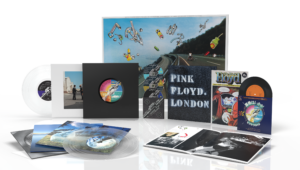
And if all that isn’t enough for you, there’s also the deluxe box set, which has everything – and a little bit more. Not only does it contain CD, Blu-Ray with high quality audio and multi-media, and 3-LP clear vinyl versions. But then, there’s also a special extra vinyl disc titled “Live at Wembley”. This bonus disc – only available in the deluxe set as a fourth clear vinyl disc – includes live versions of “SoYCD” and “You’ve Gotta Be Crazy,” both of which were released on CD in the previous WYWH Immersion reissue in 2011.
But what else then? Well, the deluxe box set incudes a replica Japanese 7-inch single of “Have A Cigar (edit)” b/w “Welcome To The Machine”, videos of concert screen projection films, a short film about PF’s album cover designer Storm Thorgerson of the visual design team Hipgnosis, a hardcover book with unseen photographs, a copy of the famous Hipgnosis-designed 1975 Knebworth Festival poster promoting the Floyd’s performance, and a replica of PF’s amusing comic-book tour program from that era. (That program’s centerfold is decorated with a grotesque caricature of the four band members by the later-on Wall album cover artist, Gerald Scarfe. And who wouldn’t want that?) But to get all those extra goodies, you may be giving up quite a few cups of your favorite gourmet coffee!
So, from here, join me for a backward spiral through the Time Tunnel to the days before the first blips of Wish You Were Here ever came up on Pink Floyd’s then-state-of-the-art Transfer Globes.
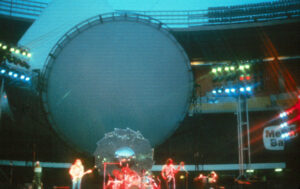
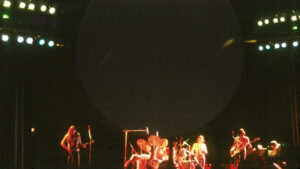
I was one of the lucky ones, or so I had thought. It was right in the middle of my 21st year – June 20, 1975, to be exact – that I had a golden opportunity to witness the live preview of new Pink Floyd songs in concert that would not only provide large swaths of the band’s next two post-Dark Side of the Moon studio albums but also go on to become time-honored classics in the deep PF repertoire.
The only problem was that the material was so squeaky-new and unexpected at the time that few of us in the audience could begin to wrap our heads around the deceptive complexity of this unsettling new music. How could we, really? It would take a while – and the eventual release of those next two PF albums, 1975’s Wish You Were Here and 1977’s Animals – for some confirmed Floyd fans like me to finally and fully digest that dense glomp of tunage we had heard in that first set that year.
In other words, it just didn’t seem so ‘great’ to some of us at the time. For sure, many in the audience visibly enjoyed the new music with abandon as part of the overall general-admission stadium concert experience and – unlike me – likely didn’t feel the need to analyze it too deeply. But, to my ears, these new offerings seemed to lack the subtlety and mystery of earlier Floyd, and I couldn’t shake that feeling for some time. A little too much of that “just crank it up and rock” arena-rock vibe for me at the time.
After all, it was the full run-through of “Dark Side of the Moon” and encore of “Echoes” which would come later in the show that many fans in the audience could really dig into. And the more rabid ones like me and my small group of friends – early PF adopters from the band’s late-‘60s period of psychedelic experimentation – were expecting at least a few other things, too. Obviously, we needed to lower our expectations.
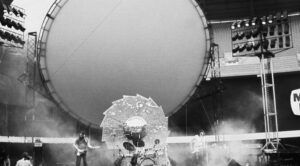
It seemed so clear to me that June night in 1975 at Pittsburgh’s once-upon-a-time Three Rivers Stadium. Like a sudden collision with a thoroughly wasted concert fan, it hit me that a sold-out, 50,000-head stadium was not the best setting for introducing a large chunk of unknown music to a hot, restless and too-partied-up audience. (It was over 90 degrees at showtime, roughly at 7:30 p.m., and the stage was still in full sunlight. Tempers and attention spans were short, and words were flying on the field. Maybe a few fists, too. From my POV about 50 yards from the stage, I sensed a gaping disconnect between the band and audience. While introducing a song mid-set, PF bassist Roger Waters had even chided the crowd, shouting out to us that we’d “have to be a little bit quieter!” Just a wild guess, then, that he had felt it, too.
Barely three months later – on Sept. 12, 1975 – the band quietly delivered a mysterious, new vinyl LP to record shops and department stores, done up in an almost-monolithic package of dark-blue shrink wrap. Reportedly, the original plan was to not have any label on the outer cover. But the record company, perhaps in a bit of a panic, rushed out a circular adhesive label containing the album and band names, set around the now-classic graphic of robotic hands shaking over a colorful quadrant of exotic landscapes. That same image was also replicated on the LP’s center label in more subdued blue and black line art.
When that shrink wrap was torn off and the vinyl first hit my turntable, the songs on it at first listen still seemed dense and opaque, like morse-code from another solar system. And some of the songs definitely didn’t even sound like most of what had been performed live in Pittsburgh. (“Maybe that first song sounds like something from the show – I dunno. . .” I thought to myself after hearing ”Shine on” coming through my home stereo speakers the first time.)
The cryptic, Hipgnosis-designed photos that adorned the hidden album cover and the inner sleeve – like the burning businessman on the stark white front cover, the veils blowing in the wind, the faceless and transparent record salesman in the sand, or the diver making no splash in the lake – did very little to relieve the cognitive dissonance. Maybe it was just easier for the more casual, recent-adopting PF fans, who knew less of the band’s pre-Dark Side work and weren’t expecting so much. (Y’know, less baggage, fewer preconceived expectations.) But, for the hardest-core PF fans like me who were infected with ‘Floyd Disease’, learning to love this new music was not so easy. But, at least, finally having some of it on record seemed like a better place to start.
Yes, that mysterious new album turned out to be Wish You Were Here. So – isn’t it kinda funny? – here we are, fifty years later, still talking about it, still celebrating its then-cutting-edge sonic landscapes, still basking in those shadowy and pungent critiques of human weaknesses and misunderstandings. And, now, we have brand-new packaging and formats to help us celebrate its many levels and textures, and to further decode its seemingly encrypted messages. What else could we possibly learn?
Although Pink Floyd was still, in theory, a four-man band at the time, those messages were definitely coming from one member in particular. Through his efforts as the sole lyricist for the Dark Side of the Moon album, PF’s bassist, vocalist and co-founding member Roger Waters had fully evolved into being their chief conceptualist and songwriter by the time the first sparks of WYWH had started flickering in early 1974.
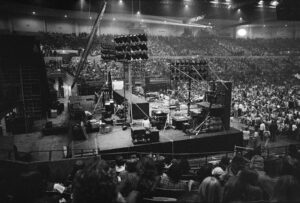
Reportedly from many sources (including Waters himself), the band had been feeling creatively drained by all the touring and general hoopla surrounding DSotM. He especially has recalled numerous times that morale in the band had fallen so low and inspiration was so hard to find that they all sort of wished they could be somewhere other than in the studio, doing anything else but working on a new album. As a certain now-immortal song lyric on the album would say, for posterity, “Ya gotta get an album out. . .you owe it to the people. . . .“ So, indeed, the stakes were high. Matching or even surpassing the unearthly mega-success of DSotM became PF’s daunting task. And it soon began to weigh down on them like a millstone.
So devoid of new musical ideas had the four musicians supposedly become that they even briefly experimented in early 1974 with a left-field concept of making an album without musical instruments. Instead they dabbled with things like bottles, springs and rubber bands. Although soon aborted after a couple of attempted recordings of arranged bits of sound effects, the Household Objects project – as it had been loosely called within the band – still gifted them a crack in their creative block. And, luckily enough, some of those learnings made their way into the final recording of WYWH. For instance, there’s the humming-wineglass effect used at the beginning of “SoYCD” that blends into the synthetic, funereal drone of the keyboard prelude. (An excerpt of this early experiment is included in some versions of the new reissue, as it had also been on the now-out-of-print Immersion reissue of WYWH in 2011.)
In any case, Waters had found himself chewing over the increasing sense of emptiness and apathy that had settled into the soul of the band in the latter days of their Dark Side touring era. (As he has often explained, all of their career ambitions up to DSotM had been fulfilled beyond their wildest dreams, and yet there was a nagging sense of it not being enough, of their somehow having failed.)
In hindsight, perhaps, it’s really no surprise, but that is exactly what Waters had begun to put down in words. Slowly, a theme of loss, regret and guilt – and of not being here – began to rise from the ashes, like a reanimated spirit. And it wasn’t just any spirit but actually that of long-departed original founding member, guitarist and songwriter Syd Barrett, who had left the band after PF’s first album, due to an all-too-well-known personal crisis, in early 1968. In time, each of PF’s members had come to realize just how much the visionary Barrett had contributed to their eventual success. That’s where their keening sense of guilt and personal indebtedness came in.
“Shine on You Crazy Diamond” – a song Waters would often introduce in live shows by saying it had “something to do with Syd Barrett” – proved to be the only one of the two new songs that would make the cut for WYWH to be premiered in concert before the album’s release. Other flavors of resentment with a sarcastic aftertaste soon emerged. One especially bitter sentiment was unmistakable: Being trapped in the music business and having to outdo themselves while the bean-counting record company execs held a stopwatch over their heads was demeaning and infuriating. No, it’s not hard to see how other malcontented WYWH songs like “Welcome to the Machine” and “Have a Cigar” – and even the title track – came pouring out once a tangible theme emerged.
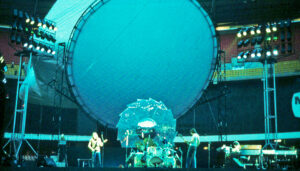
And, in fact, it was not the summer of 1975 but 1974 when “SoYCD” made its first live appearance, on June 18, ever so slightly more than one year before that U.S. performance I experienced in Pittsburgh. In Summer 1974, after a much-deserved six-month break from the road, the band had made a surprise return to the stage with a short run of new dates in France that some have dubbed the Europe Summer 1974 tour, after the fact. (That “tour” consisted of only seven shows, and only in that one country.) “DSotM” and a couple of other Floyd oldies were still in rotation, and the band wasted no time introducing the very long “SoYCD” as the very first song in those shows.
Remember this: It had only been written not quite two weeks before the first show.
Reportedly, the multi-section piece had grown out of parts that Waters, guitarist David Gilmour and keyboardist Richard Wright had each sketched out independently of each other. (The first half on the original album was labeled as Parts I-V, and the second half of was Parts VI-IX.) It was centered around a B.B. King-“Thrill Is Gone”-like, G-minor blues guitar tonality (Hmm. . .Was that guitar vibe a Floydian slip?) But it also incorporated elements of G-harmonic minor in various sections and transitions, and the piece’s true hook came from an accidentally discovered and wistful, four-note guitar arpeggio, with a haunting, watery delay effect. (Yeahhh. . .that one!) All of it was miraculously stitched together as one, continually evolving musical theme.
According to the often-cited story, Waters had overheard Gilmour just noodling on the guitar in June 1974 when he heard those ghostly four notes. Waters zeroed in on it right then. It served as a catalyst that quickened assembly of the piece into a working whole. So, for the summer concert dates, the band would have at least one new piece in the bag.
“Shine on” – now the celebrated Barrett homage but also a kind of lament for all of us silly, absent-minded humans – has spread a very bright corona over PF history. But in those early days, it did not always project such a sunny aura. The approximately 25-minute-long piece would take up just as much space in the live show as on the record, even though it only formed the opening and closing of the original vinyl record.
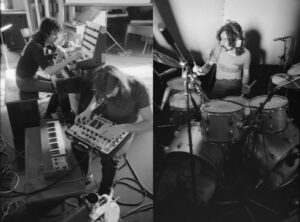
In late Fall 1974, after more studio work and writing, the band undertook another abbreviated tour in the UK, where that song got more stage time and chances for getting the kinks worked out. (This time, the band managed to log 20 shows, all on their home soil.) And, yes, as some audience recordings from the time have revealed, the song still had some kinky moments in that round of shows.
Even with the lyrics of “SoYCD” printed on the inside back cover of that wacky comic-book-style tour program we mentioned (Subtitled, “Super All-Action OFFICIAL Music Programme For Boys and Girls!” and replicated for the deluxe box set.), the song’s many layers of meaning were not immediately clear to audiences in those early airings. And being performed as one continuous, often meandering, multi-part showpiece could strain the attention and patience of even the most ardent Floyd heads.
Around the time of the Fall ’74 tour, critics in the British music press had also started balking over the band’s new material. Barely even praising the band with faint damns, some questioned whether the band had lost their “touch” or were even still “relevant.” This was, after all, the same era as the dawn of Disco and Punk, so progressive rock – Floydian or otherwise – was quickly finding itself falling out of favor.
When it came time to committing “SoYCD” to audiotape in the studio, the band and their producer quickly realized that the long piece needed to be broken up into two halves. With this neat feat of bookending the record, the album could then be anchored thematically. It also cleverly left space to the end of Side 1 and on the opening of Side 2 for other songs.
So, perhaps, it’s fitting that one special feature of the new 50th Anniversary reissue is a newly-remixed, full-length bonus version that joins the two halves into one continuous piece, just as it had been first arranged in 1974. (As the full advance clip of this spliced version on the Pink Floyd YouTube channel proves, this shimmering new remix reveals many vocal and keyboard nuances we may have missed before. And all variations of the new reissue also include an early instrumental version, in its rawest form.)
The piece also became more refined with some of the sprawling parts getting shaved back – especially those near the end – to allow for fitting it into the finite space of the LP format. In fact, some of this compression also led to a bit more of an opening for keyboardist Richard Wright to wedge in a more ethereal, multi-keyboard coda. (Sharp-eared fans might notice that this Part IX section is also quite reminiscent of a haunting, piano-based Jerry Garcia composition, “Eep Hour”, on his 1972 solo album, Garcia.) And though this truly grand finale with plaintive guitar phrases interwoven with Wright’s orchestrally-arranged keyboards hovers between triumph and surrender, it resolves as a bittersweet, goodbye handshake-and-hug with the band’s old friend Syd.
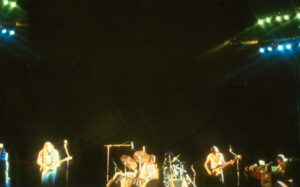
Another new lengthy piece that had been debuted at the time but held back for the 1977 Animals album was “Raving and Drooling”. (For better or worse, we all know it now as “Sheep.”) So, lined up in that first set in Summer 1974 with another sprawling, multi-part epic from the then-not-so-distant past (that would be “Echoes”), even just having “SoYCD” and “Raving” added to the set still presented a meteoric chunk of unknown sonic territory for the unwitting French audiences to unpack.
“Raving” did survive into the 1974 UK dates, then over to the 1975 round of North American concert dates as well. Still, it was likely far too long to fill in the ‘music hole’ left on the planned vinyl album and would have to be shelved. The same would be true of another extended song, “You’ve Gotta Be Crazy”, later re-purposed as “Dogs” on the Animals album. The then-brand-new song was also squeezed into the set during the Fall 1974 run, with primary vocalist David Gilmour spitting out way too many lines of lyrics at a breakneck speed.
“Crazy”, too, had a prominent Set 1 slot on the North American tour the next year, and, thankfully, the lyrical phrases had since been pared back and slowed down to allow Gilmour time to catch his breath. (This new-and-improved version is included in the full April 1975 LA live show on some of the different 50th Anniversary formats in the 50th Anniversary reissue. And, if you’re at all curious, the ‘machine-gun’ lyrics version was previously released on the 2011 WYWH Immersion set and now can be found on the bonus clear vinyl LP in the new WYWH deluxe box set.)
A newer live song that got miraculously tapped for inclusion on WYWH while the others were taken out of consideration – “Have a Cigar” – also did not exist at the time of the 1974 French tour. It did, however, find its way into the 1975 North American shows, beginning with the April 8 show in Vancouver BC that year. In one interview following the album’s release, Waters confirmed that he had written the song’s lyrics sometime following the UK tour as a way of doing a bit of spleen venting about record company pressures. Interestingly enough, that special comic-book tour program which we mentioned listed the lyrics of three new songs in hand-written form, presumably Waters’ own hand. But “Cigar” was not one of them. (Those three songs listed on the inside back cover of the program were “SoYCD”, “Raving” and “Crazy”.)
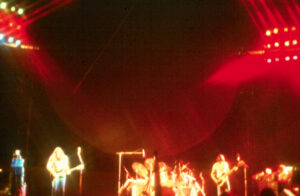
Nonetheless, the scathing and crunchy arena-rock number “Cigar” – sung in character on the studio recording by guest vocalist Roy Harper – surfaced in the 1975 set as a continuous bridge between two halves of “SoYCD”, with Waters and Gilmour sharing the lead vocal. This sequencing was actually a brilliant stroke of song pacing that helped to break up the tedium of that often-plodding concept piece. (Not to be overthinking this too much, but, perhaps, this insertion of “Cigar” between the halves of “SoYCD”, just three months before the release of WYWH, was also a nod toward its eventual placement on the album.) Still, since the song’s lyrics had not been added to the tour program for the 1975 NA tour, none of us could have realized that another new song had sneaked itself into the middle. (Note: This special sequencing can also be heard on the 1975 LA show recording.)
The two songs on WYWH that had never enjoyed the benefit of having live trial runs were Side 1 closer “Welcome to Machine” and the title track on Side 2, “Wish You Were Here”. The latter is, of course, the Hendrixian, 12-string-guitar country-blues lament carrying “Have a Cigar” – via a change of radio station – over into the wind-blown wilds of the concluding half of “SoYCD”.
Synthesizers play a big part in the sound of the WYWH album, but nowhere more fittingly than on “Welcome”. Yes, PF had used synths freely on previous recordings, including 1972’s Obscured by Clouds and Dark Side of the Moon in 1973. But the impact of hearing the oscillating and soaring high-tech synth layers on “Welcome” for the first time is hard to convey from 50 years out. Still, it was, to say the least, a mind-bender at first spin. In fact, maybe even more of a shock than “On the Run”, the techno-bomb instrumental section of DSotM which also has a tendency to come screaming out of the speakers.
In comparison, the final version of “Welcome” started off as an ominous, slow-burning track full of hissing steam and factory sounds which then came out of left field with its searing synth leads erupting from the stereo channels. And then, after a few listens, it would invariably grow on the listener. (It did for me, and I know the trippy Side 1 closer also quickly became a favorite track among the PF fans in my circle.) But now, thanks to the early demos on the 50th Anniversary box, we can hear it in its more stripped-down, Roger Waters demo form as “The Machine Song”, and there are two versions included among the new rarities.
One is a more guitar-centric original Waters home demo with some synth pulsing and swooshes, and the second is more fleshed out but still the basic song form without the soaring synth passages slathered on and Waters still handling the vocal. (For the most curious among you, an advanced clip of version #2 with Waters’ more reverb-soaked vocals can be found on Pink Floyd’s YouTube channel.) Clearly, this is not a song that the band meant to try out on unsuspecting concert audiences!
As for the album’s title track, “Wish You Were Here”, it has been described as having come about in a type of a meeting-of-the-minds between PF guitarist Gilmour, who had written a portion of the song’s progression on 12-string guitar, and Waters, who had already sketched out a good part of the lyrics. Waters had liked what he heard in the PF guitarist’s early prototype and then worked more on the lyrics and extended the progression to complete the song.
Several versions of “WYWH” are now included on the Anniversary variations, including an instrumental version with Gilmour playing a lap steel guitar melody and a version with a violin accompaniment contributed by French Gypsy Jazz legend, Stéphane Grappelli. (Full disclosure: The Grappelli version is not a recent discovery, as it had been included on the previous WYWH Immersion reissue in 2011 as a discarded take. But the lap steel version – again sounding very Garcia-esque with its dreamy, drifting melodic steel-guitar fills – is a newly-unearthed gem that helps us to hear the song more clearly under construction and moving toward completion.)
It was, for me, after maybe as many as five or six first listens, all those years ago, when the logical, parabolic structure of the entire album came suddenly into focus, like refracted light through a diamond turned just right. Previously, I had only gravitated to the white-knuckle synth attack of “Welcome” and the churning, anti-music-industry satire, “Cigar” as obvious ‘go-to’ songs. I thought the title track was just OK, even if it seemed the band sounded somewhat adrift and in doubt about their future survival. (“Could this be their last album?” I wondered.) And I was still decidedly non-committal about “Shine on”.
But then, upon further listening, I found myself most impressed with the sly shifts in momentum and accumulation of meaning in the arrangement of “SoYCD” as it revealed its multiple facets and the lyrics began to congeal for me. What had been hatched in the live performances seemingly as one long, blues-ey/synth-ey dirge by only the four band members had been transformed – through deft arrangement and production with vocal and saxophone sweetening, double-tracked and harmonized guitar melodies, and a raging lap-steel guitar solo – into a smoothly-flowing suite of distinctly different styles. First, Cosmic Blues. Second, Smooth Jazz. Next, Progressive Space-Rock. Then, a chugging clavinet Disco-Funk jam-out. And, finally, that grand Rick Wright piano-synth orchestral finale.
In that moment of clarity, the lyrical themes of the album all snapped together perfectly for me, like a completed puzzle. My main takeaway was that the band had tapped into a profound musical truth: The same basic musical elements – like that fistful of blues chords at the heart of it – can be endlessly massaged and molded, in so many ways. So Wish You Were Here finally rang true for me, as a concise, coherent statement about grappling with a blank canvas – or even one’s own identity crisis – and still coming out on the other side, proudly, with a finished picture. And maybe even venting a few spleens along the way. Shine on, indeed!
Truly, one can learn much about the evolution of the timeless Wish You Were Here album by delving into all of the bonus material in the new Anniversary reissue versions, from the outtakes to the in-progress live performances. While some of the bonus material obviously had existed on previous releases or out on YouTube in the world of unauthorized audience recordings (as in the case of the 1975 LA show), there’s much that’s new to younger, less obsessive fans. There’s nothing quite like diving into the new versions head first and swimming around in it for days on end. Just make sure you come up for air once in a while or you might get stuck there, just like that diver on the classic, Hipgnosis-designed WYWH inner sleeve.
Swim on, then, brave Floyd fans!
Wish You Were Here 50 Tracklisting & Formats:
* never before officially released
DIGITAL DOWNLOAD FORMAT
Disc 1 – Original album
Disc 2 – Bonus Tracks
Disc 3 – Live Bootleg – Steven Wilson Remix
2-CD FORMAT
Disc 1 – Original Album & Bonus Audio
Disc 2 – Bonus Audio
3-LP FORMAT
Side A – Original Album
Side B – Original Album
Side C – Bonus Audio
Side D – Bonus Audio
Side E – Bonus Audio
Side F – Bonus Audio
BLU-RAY FORMAT
Wish You Were Here original 5-track album
Bonus Audio (stereo)
Live Bootleg (stereo) – Steven Wilson Remix
Videos (concert Screen Films)
DELUXE BOX SET FORMAT
Includes all 2-CD, 3-LP (on exclusive clear vinyl) and Blu-Ray formats listed above, plus:
A fourth clear vinyl LP titled: “LP-4” – Live At Wembley 1974
Side G – Live At Wembley 1974
Side H – Live At Wembley 1974
Plus: