Article Contributed by Mike
Published on 2025-12-09
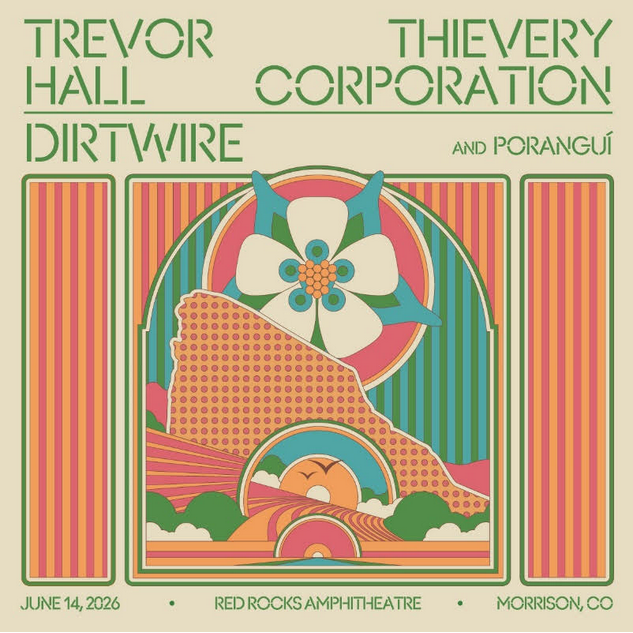
Sunday, June 14, 2026
Trevor Hall, Thievery Corporation and Dirtwire, with support from Porangui, will join forces for a powerful night at Colorado’s legendary Red Rocks Amphitheatre in summer 2026.
Blending spiritual songwriting, global electronic grooves and genre-bending roots experimentation, this one-of-a-kind bill promises a deep, transportive experience in one of the world’s most iconic outdoor venues.
Red Rocks Amphitheatre
16860 W Alameda Pkwy, Morrison, CO 80465
Sunday, June 14, 2026
TICKETS ON SALE FRIDAY, DECEMBER 12 AT 10AM MT
Tickets available here via AXS
Raised on the coast of South Carolina, Trevor Hall discovered early on that music wasn’t just a passion—it was a calling. At sixteen, he recorded his first album and soon after moved to Idyllwild Arts Academy in California, where he studied classical guitar and was introduced to the spiritual traditions that would become central to both his life and his work.
Blending roots and folk with subtle electronic textures, Hall’s music explores themes of love, transformation, and connection. His deeply personal songwriting and global influences have cultivated a loyal fan base and carried him to iconic stages on sold out tours around the world.
His live show brings his unique blend of captivating music and soulful storytelling to the stage, illuminating the pivotal moments, travels, and teachings that have shaped his path. Offering a rare and tender glimpse into Hall’s inner world, the show is a one-of-a-kind experience not to be missed.
Twenty-five years into their genre-defying electronic music career, Thievery Corporation’s founding principles of D.I.Y. and inclusion have become key themes in mainstream social conversation. After a dozen highly acclaimed full-length albums, remix LPs, concert recordings, and over two decades of incendiary performances that have thrilled audiences worldwide, Thievery Corporation’s music and message is more relevant and important now than ever.
That lack of filter enabled Garza and Hilton to mine their musical inspirations and create one of the most unique bodies of work in electronic music, respectfully incorporating tastes of international cultural styles, without ever falling into the trap of cultural appropriation. “We always wondered: with so much incredible music in the world, why would anyone limit themselves to one genre? Well, we found out — it’s far easier to stay in one lane than to genre hop!” laughs Hilton. Garza elaborates: “When we started, we were influenced by music from all over the world, flipping through bins in second hand record stores for LP’s from Brazil, India, Iran, Jamaica, jazz records…..we wanted to make music where you didn’t know whether it was recorded today or a decade ago.”
Thievery Corporation’s music has always looked toward the future while paying homage to the past, starting with their groundbreaking debut LP, 1996’s Sounds From The Thievery Hi-Fi, which both introduced the world to Garza and Hilton as producers and set their course as pioneers of song-based electronic music with wildly diverse vocalists.
The band’s legendary D.C. headquarters, the Eighteenth Street Lounge, became an epicenter for a diverse group of people and staff from all over the world, which in turn had a profound influence on their musical output. “D.C. was very cosmopolitan, lots of places to see international live music and jazz,” says Garza. “We’d run into people from all over the world and invite them to play with us — so Thievery became an extension of that, both on our records and in our live performances.”
Indeed, Hilton and Garza’s “Outernational” approach created a world reflected by the artist’s ideals of diversity and acceptance. “25 years after we started, it seems like the world is catching up,” Garza opines. “Social consciousness is more mainstream, awareness of the importance of inclusivity…it’s so encouraging to see so many people working towards these goals in America.” Hilton agrees. “Thievery is a reflection of who we are, it evolved from our musical tastes. Artists who were for the people, like The Clash, Fela Kuti, Manu Chao were so important to us, and engaging in social ideas has always been a part of what we’ve tried to do.”
People don’t refer to Thievery Corporation as “World Music,” but it’s safe to say that their music and ethos is global in its scope and ahead of its time at every turn.
In a live setting, Thievery Corporation avoids any electronic dance music tropes. Yes, you’ll dance, sweat and put your hands in the air… but their concerts are true performances, with a band of players and an array of vocalists from diverse global cultures. No two shows feel the same. “Our shows are VERY live, lots of energy, the combination of multiple instruments and singers that take you on a musical journey,” says Garza. “We have a sitar player, songs are in different languages — it’s a multicultural experience, people connect to the band and to each other, it’s beautiful.”
With a world cautiously beginning to emerge from isolation and towards communal events, Garza is eager to return Thievery Corporation to the stage. “I feel like people have been waiting to celebrate together after being forced apart for too long. We’re all craving that.”
Eric Hilton’s presence at Thievery gigs, however, has become an increasingly rare event. “I never really embraced touring; some of the world tours were interesting, seeing new places and cultures,” he says. “For me, touring was tourism. The creative process of making music is more my thing.” And Thievery Corporation have brought the sounds of the world to listeners throughout each of their albums. “There are so many highlights for me. 2014’s Saudade is my favorite record that we’ve done, a real creative stretch for us. Quiet music is hard to make! Symphonik also. To hear our music done with an orchestra was incredible.”
Hilton concedes that over time performance influenced the studio records. “After Cosmic Game (2011), we orchestrated jam sessions and built the records from those. For Temple of I and I (2014), we went to Jamaica to jam and record, which gave that record a different feel and authenticity.”
Looking back over their career, Rob Garza and Eric Hilton acknowledge that what drives each of them may be different, but the mashup of personalities, sounds, cultures and experiences birthed something wholly unique. “We love all kinds of music, which is why Thievery Corporation sounds the way it does,” the founding partners agree. “We couldn’t possibly incorporate all our tastes into the music, but we do it more than most.”
By not following trends or the whims of major labels, and embracing the cultural diversities that make the world such a wondrous place, Thievery Corporation has created a legacy that runs deep and continues to expand. “Over 25 years, we’ve left nothing undone. We far exceeded what we thought we would do,” Hilton and Garza agree. And Thievery Corporation’s music will continue on to reverberate and influence the next generation of listeners with an ear toward a global musical experience.
Dirtwire stands poised between ancient Mother Earth and modern technology, a blend of ethnomusicology and the psychedelic trance state, gut-bucket delta blues and what the band variously dubs “back-porch space cowboy blues, swamptronica, and electro-twang.” It’s a sound informed by Dirtwire’s travels and performances around the globe, where East meets West and North joins South. From the favelas in Brazil, Femi Kuti’s Shrine in Lagos, Tokyo’s bluegrass clubs, Ayahuasca ceremonies in Central America, Gamelan performances in Bali, desert festivals in the Australian Outback, and the 20th anniversary of Kazakhstan’s modernized new capital Astana, the band spreads its message by building bridges across musical cultures in their own unique way.
Dirtwire plays an array of instruments both ancient and modern, including West African kamale ngonis, jaw harps, space fiddles, whamola basses, Rickenbacher electric 12-string guitars, bowed banjos and mouth harps from around the globe, all interwoven into modern laptop beat creation. Hailing from the underground west coast electronic bass music scene, Dirtwire finds itself at the forefront of experimental electronic music production, mixing in their wide array of world instruments with sampled beats and 808s.
Dirtwire’s shows are a communal psychedelic journey, ranging from down-home boot-stomping get downs, to bass and blues electronic mashups, to ethereal cinematic beat-driven soundscapes. Woven into each is the exploration of where live instruments meet computer production, and where tradition meets experimentation.