Article Contributed by Janine Catchpole
Published on 2026-02-10
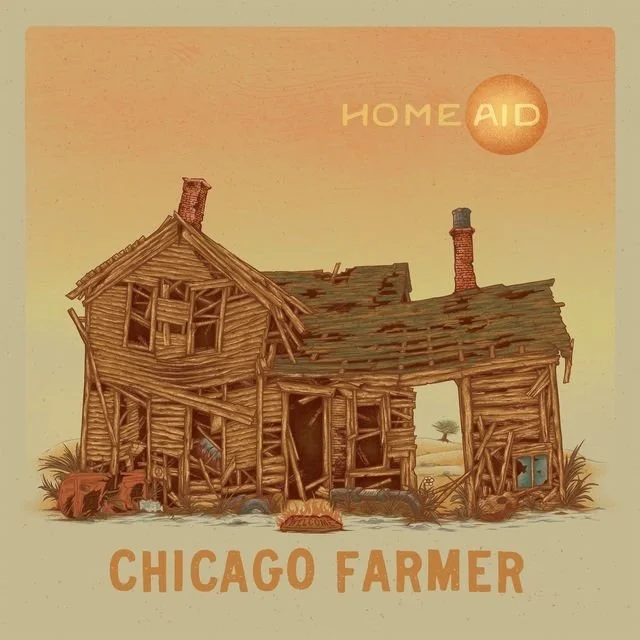
Chicago Farmer & the Fieldnotes have always lived inside a paradox: chasing places while searching for the one that lets you finally hang your hat. Where do you belong? How does a place define who you are—especially when life keeps adding “more people, more places”?
Maybe you need a team to help you build the tours, widen the sound, and give the songs a bigger frame. Hence, The Fieldnotes. For Cody Diekhoff—the man behind the stage name Chicago Farmer—that long-held vision is now fully realized: the artist name paired with the band name he imagined years ago.
Homeaid, about to be in the hands of many fans, marks the second time The Fieldnotes have recorded with Chicago Farmer. In 2022, he released Fore!!!!, an extended play format of four songs with help from Althea Grace on “When He Gets That Way.” The Fieldnotes include Jaik Willis (Diekhoff’s longtime friend) on guitar, with some Bloomington, Illinois folks—Charlie Harris on bass and Cody Jensen on keyboards and mandolin. I do miss the amazing sight of Jensen playing both drums and keyboards (or trumpet) at the same time back before The Fieldnotes acquired Frank Kurtz on drums.
Chicago Farmer centers his songs and stories on his hometown and Central Illinois influences—his worldview. But chasing a career toward big cities honed the typical south-of-Interstate I-80 view with a little city cynicism and an expanded perspective. (Many people in the greater Chicago area see anyplace south of I-80 as “downstate,” which can cause some polarization.) After a lot of years of watching Chicago Farmer, I hear growth in the songwriting that reflects a deeper appreciation of folk song heritage and its forms, along with the background of his upbringing. He hears the song in the everyday events of small-town life, and we help shoulder those memories into the future in a land where populations often diminish—and the stories can vanish with them.
Listening to Homeaid sent me back into my collection of Chicago Farmer music and videos. This sophomore excursion from Chicago Farmer and The Fieldnotes should be regular listening for fans. We appreciate hearing the musicianship of the band and songwriter in a more formal presentation, and the players bring the pro-level skills needed to elevate the songs to a new tier. Recordings help me learn the music, but a live performance always has more soul.
“Tina Hart’s Mustang” opens Homeaid and fits the mode of a memory song—capturing a lifestyle, the culture of hot cars, and a legendary driver. Willis and Jensen add small touches that highlight the emotional journey of the storytelling. Consider it the warm-up to the passion of “Peshtigo.”
I first heard “Peshtigo” on March 25, 2023 at The Main in La Crosse, Wisconsin. The Fieldnotes were still just three—Willis, Jensen, and Harris. Now, with Kurtz on drums and Harris’ bass, the fire blazes hotter: Willis’ guitar is urgent and fierce, reflecting panic as the flames rage across towns and countryside—killing more people than the Great Chicago Fire, and burning on the same date. With such support, Chicago Farmer’s voice becomes both empowered and desperate, “praying like hell for the rain.”
Consider this a place song, a memorial song—like the traditional “Baltimore Fire” about the fiery destruction of early “Baltimore, the beautiful city,” or “The Wreck of the Edmund Fitzgerald.” But here is my theory for the development of this song: as Chicago Farmer toured Wisconsin, the opportunities to see new places, to explore, did not go untouched. Social media posts of beautiful places were shared. I have visions of museum tours in Peshtigo, Wisconsin—checking out the Peshtigo Fire Museum (https://peshtigofiremuseum.com/museum/)—or the National Shrine of Our Lady of Good Help where people flocked to the safety of the church as the fire raged, praying the Rosary for the rain. Maybe poking around Williamsville, Wisconsin, he visited the site of a mill that also served as shelter in the fire storm. Now, add the twinkle in Chicago Farmer’s eye as he sees the irony of writing this song. Perhaps with our collective, the event continues to be remembered. Hard not to love a smart songwriter recognizing he’s walked into a song waiting to be born.
Chicago Farmer has matured since the blonde-surfer-boy days and his awareness of women’s stories, traditional in folk song, is deeper. There are a large number of collected folk songs about women pushed beyond limits; often murder or death ensues. “Mile Marker 25” is such a song, akin to “When He Gets That Way” on Fore!!!!. Anyone stuck inside this recent polar vortex understands “a black and blue winter” emotionally, but the song brings the desperation for freedom from a bad status quo, no matter the final costs. “But the hardest of words is goodbye,” and fire now becomes a tool for release of pain, not the cause, as in “Peshtigo.” And did I mention there is a sing-a-long refrain in the song? It is an important component to such a song.
And now for something totally different, “Mattress.” It is best when heard with the story about how the song came to be written. But humor, with a bit of an edge, is also a part of the folk song tradition. The song has Jensen in glorious funkiness on the keyboards and some country to the picking—a happy mix of sounds as varied as the abandoned mattress photos that show up in fan posts. And it has become a choice for audience challenge singing. Here are some of the trickier verse bits with associated refrains. The song has a bite.
“Papa was painter, he used to paint the town
Now he’s sittin’ in the waiting room debating
how the baby boomers laid him in the ground
It’s malpractice, it needs another coat
There’s malpractice, by the side of the road
Somebody was holding on, somebody let go
To the mattress, by the side of the road
Mama was a singer, she used to sing the sounds
Now she’s sittin’ in auditions for positions with
conditions that keep her spinning around
Like an actress, in a misleading role
There’s an actress, by the side of the road
Somebody was holding on, somebody let go
To the mattress, by the side of the road”
A favorite of mine, “Battlecry,” and the lyrics “I’ve been cryin’, and I don’t know why” describe a lot of my days. It is a song that looks at the suffering of life and accepts it for what it is. It reflects grief, acknowledges the concept of pre-grief (preparing for loss), and still hopes for good news. The country gospel sound of Jensen’s keyboards brings the song into a higher emotional state, the guitar cries for us, and the rock-steady work of Harris and Kurtz keeps us grounded.
In gospel traditions the image recurs of the family circle broken by loss—not wanting it to be broken in the here and now but accepting it with hope for the sweet by and by. “Maybe it’s this circle, will it be unbroken.” Personal preference is for this song live, wherein a true alleluia, black dirt revival moment arises. The search for studio perfection can bring a deliberate feel to the music.
I was surprised to see “The Twenty Dollar Bill” on this recording. But given the loss of a good man, its inclusion makes absolute sense: to honor the grandparents with this song of the evil big city with a murder thrown in, because it’s what folk songwriters do. It appeared originally on the 2013 Backenforth, IL release and is a crowd favorite. Jensen’s mandolin adds folk song lightness to a grim topic.
“Homeaid,” an ode to the simple joys of home and place, delivers a mood felt by many people at this time: the need for a place where your heart can rest, where creativity and comfort can recharge you to face another journey into the world at large.
I first heard Ted Hawkins’ delightful song “Sorry You’re Sick” performed by Alex Dunn at the Bill Monroe Music Park in Indiana. The song fits perfectly into Chicago Farmer’s repertoire and the mythos he cultivates. In some rural parts where the dollar stores have not yet reached, the liquor store may just be the only place for the odd snack food to speed a recovery in addition to typical purchases. The uptempo tune brings out a brighter character to Chicago Farmer’s voice I enjoy. I think this is the first cover Chicago Farmer has recorded and released. Do take a moment to research Ted Hawkins, 1936–1995, another Black musician that never got his due.
“The Great River Road” highlights this recording for me. The title invokes deep time and history; journeys physical, emotional and spiritual for individuals and for all of us connected together in this here and now. Willis’ guitar is almost a bit raw and rough for me but we all have different interpretations of how it feels to see the wheels turn in a family’s generations. We all wander down that great river road eventually and at a certain point in your life the realization comes that it’s the ride of your life. It’s a great song that will keep well as years go by as a folk song should.
I had to look to see songs existed about a great river road and did find Sylvia Tyson’s song “River Road.” (Ian & Sylvia were folk singers in the ’60s and ’70s and song credits include great tunes like “Four Strong Winds.”) Her song is about a young woman escaping her small town and chasing her dreams. It became a big hit for Crystal Gayle (Loretta Lynn’s sister) in the mid-1970s. I’m sure it was all over the radio in Central Illinois at the time, and probably invoked dreams for many young people feeling trapped and wanting more.
The road always beckons. Chicago Farmer describes road time as a way to get in touch with thoughts and ideas, the zen journey. Thank you Chicago Farmer and The Fieldnotes for this album. I look forward to a good listen while on the road. And be safe out there on the roads as you tour and bring us more thoughtful songs, my friend.