Article Contributed by DL Media
Published on 2026-04-30
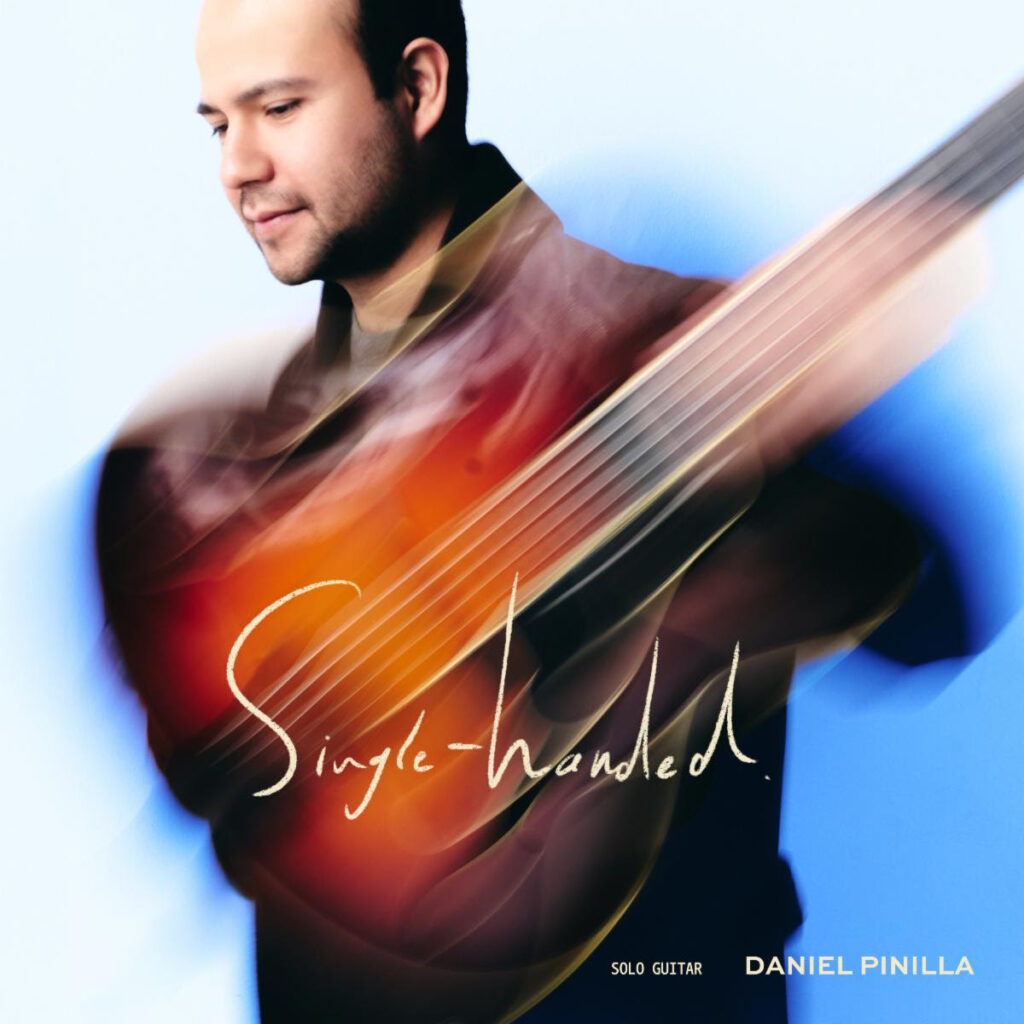
Colombian-born guitarist Daniel Pinilla announces Single-Handed, a solo guitar album that explores the instrument as a complete musical environment. Rather than treating the guitar as a reduced ensemble, Pinilla approaches it as a self-sufficient voice, capable of sustaining melody, harmony, rhythm, and form within a single, continuous musical fabric.
Listening to Joe Pass, George Van Eps, and Johnny Smith, Pinilla was struck not only by the beauty of their sound but by the mystery of how they made it happen. That curiosity became a discipline. Learning their techniques gave him both comfort and confidence and gradually shaped his identity as a musician.
On his first two albums, he included solo performances that were entirely improvised in the moment, with little pre-arrangement. He wanted to experience the act of “making it happen” in real time. Over the years, that instinct developed into a more deliberate exploration of form, pacing, and architecture.
Single-Handed grew from a simple but demanding idea: to treat the solo guitar not as a reduced ensemble, but as a complete musical environment. Each performance seeks to carry melody, harmony, motion, and pacing simultaneously, not as separate layers, but as a continuous fabric. The title also reflects the production process: this album was recorded and produced independently, another form of single-handed responsibility.
The repertoire consists of music Pinilla has lived with for many years. Thelonious Monk, John Coltrane, Antonio Carlos Jobim, Sam Rivers, and Baden Powell wrote compositions with strong internal architecture—music capable of withstanding close examination, or in this case, a single pair of hands.
“Rather than radically reshaping the material,” Pinilla says. “I intended to enter each structure and allow the arrangement to emerge from within it.”
Working in a solo format fundamentally changes decision-making. Time becomes a responsibility rather than a shared space. Harmony cannot be implied; it must be carried. Silence becomes structural. Pinilla began thinking less about linear display and more about weight—what notes provide stability, which inner voices connect phrases, and which tones allow the music to breathe.
“The sound of the record was intentionally intimate,” he says. “I wanted the guitar to feel close and authentic, warm but honest, so that the sound of the instrument itself could still be heard. I imagined the listener seated within the same room, as if the music was unfolding just a few feet away.”
To preserve that sense of immediacy, the performances were recorded in complete takes without edits or assembly, allowing the natural flow, vulnerability, and risk of solo playing to remain audible.
“This album is not intended as a display of difficulty,” Pinilla says, “but as a study in musical responsibility—to the tune, to the instrument, to time itself, and to the listener.”
---
About Daniel Pinilla
A versatile and inquisitive guitarist and composer, Daniel Pinilla has developed a distinctive artistic voice at the intersection of jazz tradition and contemporary improvisation. Much of his work explores the guitar as a self-sufficient orchestral instrument, examining how melody, harmony, rhythm, and texture can unfold simultaneously within a single performer.
Alongside his performing, recording, and teaching activities across a wide range of musical settings, Pinilla currently serves as an Assistant Professor of Jazz Guitar at the University of Michigan.
Rooted in the lineage of jazz while shaped by broader musical currents across the Americas, his artistic approach reflects a sustained search for narrative coherence, structural balance, and expressive detail. His performances emphasize continuity and flow, treating musical elements not as discrete layers but as interdependent strands within a single evolving fabric.
He has performed internationally in a wide range of contexts, from orchestral collaborations to small improvisational ensembles, and has worked with artists and groups including the Colombian National Symphony, the GRAMMY®-nominated UNT One O’Clock Lab Band, the Bob Curnow Big Band, Rachel Bade-McMurphy’s Glass Bead Orchestra, and Latin pop artist Carlos Rivera. His work has been recognized through features in The NYC Jazz Record and honors such as the DownBeat Student Awards.
Pinilla’s earlier work includes Intuiciones (Festina Lente Discos, 2011) and Atrás (2011), a duo collaboration with vocalist Laura Otero. His compositional voice has also been recognized through projects such as “Not Even a Portrait,” co-written with trumpeter Juan Chaves for an ensemble combining string quartet, double bass, and guitar, which received a DownBeat award for Best Small Ensemble Composition in 2017.
Across his artistic practice, Pinilla continues to refine a personal musical language grounded in exploration, precision, and expressive depth, with a sustained focus on solo performance and original composition as primary vehicles for creative inquiry.