Article Contributed by Big Hassle Media
Published on 2026-06-11
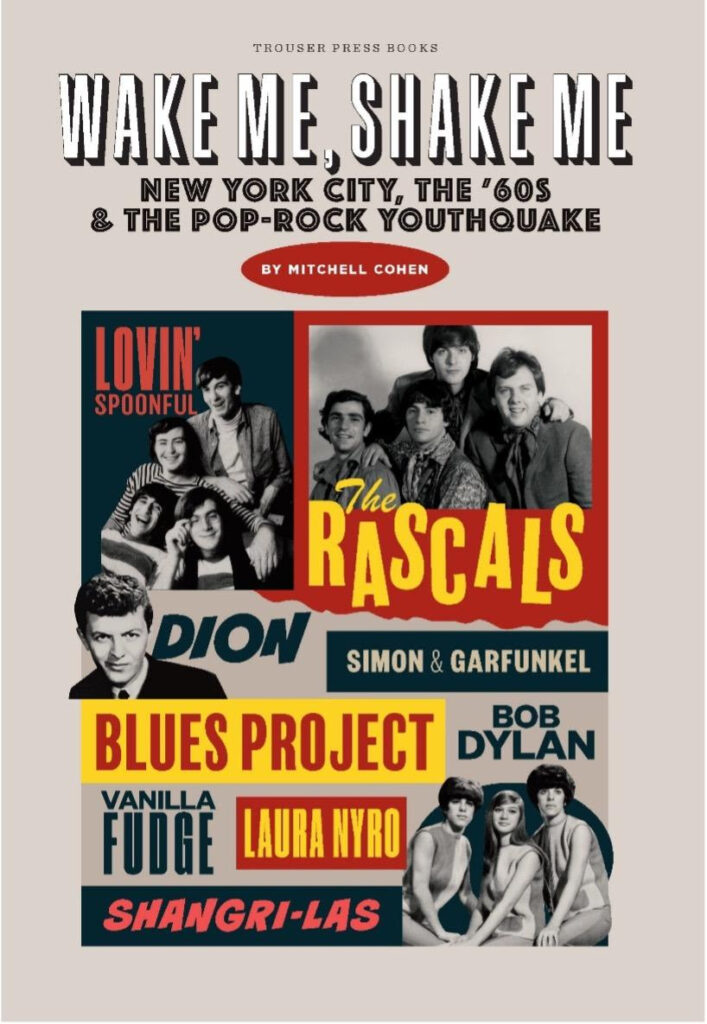
New York City in the 1960s was a musical melting pot, in which folk, R&B, rock and roll, blues, girl groups, and Brill Building pop produced a wealth of great artists and records. This book tells their story.
Using new interviews with artists and music business professionals as well as extensive archival research, Wake Me, Shake Me: New York City, the '60s & the Pop-Rock Youthquake by Mitchell Cohen, publishing September 1, 2026, charts the course from doo wop to girl groups to folk music to R&B to folk-rock to baroque rock to goodtime music with some of the city’s leading stars: The Lovin’ Spoonful, The Rascals, the Blues Project, Vanilla Fudge, the Shangri-Las, Simon & Garfunkel, Laura Nyro, Bob Dylan, Bobby Darin, and Dion. All of them make appearances in this fascinating history.
In the book, Cohen fleshes out the story with details about the songwriters, producers, record labels, TV shows, and radio stars who all played roles in creating and popularizing the music. So, Carole King, Phil Spector, Morris Levy, Alan Freed, Clive Davis, Leiber and Stoller, Mitch Miller, Murray the K, and many other colorful characters figure into it.
So do:
The book includes lists of 100 recommended albums and 100 great 45s from the ’60s.
Cohen, who lived in New York through all of this, brings passion, amusement, and curiosity to his subject, making it a vibrant, entertaining, and illuminating tale, one best accompanied by a soundtrack of great ’60s music. Cohen is the author of Looking for the Magic: New York City, the '70s & the Rise of Arista Records (2022), the co-author of Matt Pinfield’s memoir, All These Things That I’ve Done, and, with Sal Maida, two volumes of The White Label Promo Preservation Society.
From Wake Me, Shake Me:
In early 1965, there weren’t many rock groups playing in New York City. The live infrastructure to support rock and roll wasn’t in place yet. But after the Beatles it was a group culture, so while the music industry waited for high school bands formed in 1964 to graduate, bands made up of writers, producers, session musicians, and singers who were already in the biz filled the U.S. vacuum. This was possible in New York and Los Angeles, where there were people who knew how to make pop records, like Bob Feldman, Richard Gottehrer, and Jerry Goldstein — the Strangeloves.
When Bert Berns formed Bang Records in 1965, the Strangeloves, as Strange Loves, had already released one single on the Philly-based Swan Records, “Love, Love (That’s All I Want From You),” and got the idea to remake “Bo Diddley” by Bo Diddley, producing an insistent, driving track that was like the harder-edged records of the British Invasion, the Honeycombs, the Dave Clark 5. They pitched the record to Berns for his new label; he basically told them to keep the track but write a new song over it. The salacious novel Candy by Mason Hoffenberg and Terry Southern had been published, after censorship delays, in the U.S. in 1964, and was much talked about, so FGG wrote and recorded “I Want Candy.” They decided it would be cooler if the public didn’t think they were from America, let alone three Jewish guys from Brooklyn and the Bronx, but they didn’t think they could pull off British accents, so they presented themselves as the Strange brothers from Australia: Giles, Miles, and Niles.
“I Want Candy” was Bang’s first hit single, and it was followed by the FGG production of “Hang on Sloopy.” The Strangeloves were doing the song in their short live set and recorded it for their album. The Dave Clark 5, on the road with the Strangeloves on a multi-artist touring bill, told them they were going to record “Sloopy” when they got back to England. To avoid being scooped, FGG tapped a band that was backing them up in Ohio, fronted by singer-guitarist Rick Zehringer, to add overdubs to the Strangeloves’ track; they played it for Berns, the co-author of the song, and the newly named McCoys had a number-one hit.
Further endorsements of Wake Me, Shake Me:
“Cohen writes about the breadth of New York’s music with all the noise, animation and attitude of the city itself.” — Jim Farber, music journalist, New York Times, The Guardian
“Cohen conjures the hustle, magic and ecstasy of Gotham’s groove during one of its most happening eras with a helping of context that makes it all come alive.” — Dennis Diken of the Smithereens
“A wonderful love letter to the chaos, craft and blind faith behind the music of ‘60s New York.” — Sam Hollander, songwriter and author of 21 Hit Wonder: Flopping My Way to the Top of the Charts
“…the definitive book on the ’60s music business.” — Dennis Lambert, songwriter, “Nightshift,” “Don’t Pull Your Love,” and producer, Righteous Brothers, Dusty Springfield, Glen Campbell
For more information, visit TrouserPressBooks.com.