Article Contributed by Craft Recordings
Published on 2026-06-23
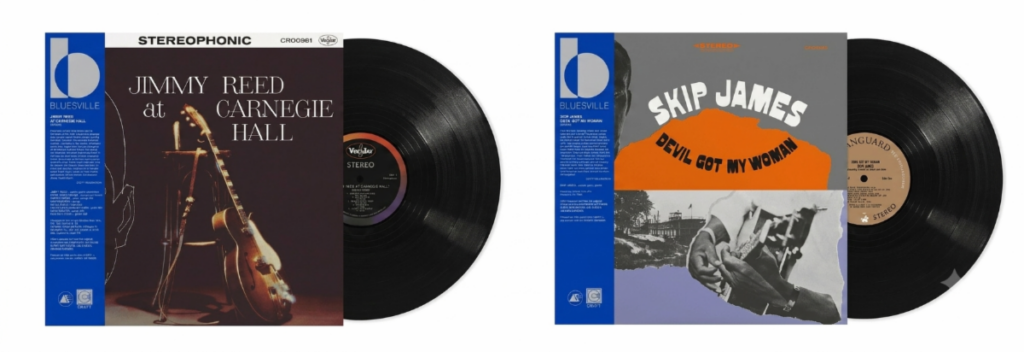
Craft Recordings and Bluesville Records are excited to announce the release of two peerless album reissues from a pair of blues heavyweights, Jimmy Reed and Skip James. A studio LP despite its name, the Jimmy Reed title is the first disc of his classic 1961 double album, Jimmy Reed at Carnegie Hall, which spawned the enduring hit song “Bright Lights Big City.” Devil Got My Woman is James’ 1968 swan song, released just a year before the Delta blues legend’s death; its title track became his signature recording.
As with all titles in the Bluesville reissue series, Jimmy Reed at Carnegie Hall and Devil Got My Woman are both AAA remastered from the original analog tapes by GRAMMY-nominated engineer Matthew Lutthans of The Mastering Lab and pressed on 180-gram vinyl in partnership with audiophile leader Acoustic Sounds. Additionally, each LP has been fitted with tip-on jackets and obis with album reflections penned by GRAMMY-winning producer, songwriter, and bluesman Scott Billington. Both albums also appear newly remastered in crystal-clear hi-res and standard digital audio.
Ahead of their August 21 release, both titles are available for pre-order and pre-save today, while newly remastered versions of Jimmy Reed's “Bright Lights Big City” and Skip James' “Devil Got My Woman” are available to stream now as advance singles.
Jimmy Reed - Jimmy Reed at Carnegie Hall
Born in Dunleith, Mississippi, Jimmy Reed (1925–1976), a Blues and Rock and Roll Hall of Fame inductee, is best known for his electric blues style, which went on to influence some of the rock world’s biggest names, including Elvis Presley, Van Morrison, and the Rolling Stones.
Decades before players were emulating him, Reed began his career as a performer and busker in and around his home state of Mississippi. He relocated to Chicago in 1943 to pursue his blue-tinted dreams, but they were put on hold when he was drafted into the Navy during World War II. After being discharged in 1945, Reed moved back to Mississippi, married his girlfriend, singer Mary “Mama” Reed, who goes uncredited on many of his records, including the aforementioned “Bright Lights Big City,” and moved again to Indiana, where he found work in the meat-packing industry.
However, Reed’s ambitions remained rooted in music. Reed’s career took off in the 1950s when he signed to Vee-Jay Records, with a little help from future bandmate and blues legend Albert King, a drummer at the time. Reed scored his first hit song, “You Don’t Have to Go,” which peaked at No. 5 on the R&B charts in 1955. A string of acclaimed singles soon followed, including “Baby What You Want Me to Do,” a 1961 Top 10 single, and the up-tempo “Big Boss Man,” a 1961 Top 20 single.
It was also in 1961 that Reed released his double album Jimmy Reed at Carnegie Hall. Bluesville’s remastered version includes sides A/B of disc 1. Though Reed did, in fact, perform at the fabled New York City concert hall the previous May — he was on a bill with the great Muddy Waters and Big Maybelle — the album instead features “studio recreations” recorded during sessions at Bell Sound Studios in New York City and Universal Recording Studio in Chicago, rather than live cuts from the venue.
Highlights include side A opener “Bright Lights Big City,” which soared to No. 3 on the R&B chart and eventually completed its run in the Top 100. An original Reed composition, the song would go on to become a country music hit, reaching No. 1 for Sonny James in 1971, underscoring Reed’s far-reaching influence across genres. It was later included in the Rock and Roll Hall of Fame’s 500 Songs That Shaped Rock and Roll. Additional standouts include “Hold Me Close,” a declaration of love, which includes blues journeyman Willie Dixon on bass, “Blue, Blue Water” featuring guitarists Eddie Taylor and Phil Upchurch, and “Tell Me You Love Me,” a co-write with fellow bluesman Al Smith.
Billington calls At Carnegie Hall “a classic Jimmy Reed album,” with “superbly recorded songs.” And PopMatters praises the “excellent quality of [the album’s] music and its subsequent importance as a touchstone recording for scores of artists.”
Click here to pre-order or pre-save Jimmy Reed at Carnegie Hall and scroll down for the tracklist.
Skip James - Devil Got My Woman
Nehemiah Curtis “Skip” James (1902–1969), born in Bentonia, Mississippi, was a bit of an idiosyncrasy in the American Delta blues canon. The singer, guitarist, pianist, and songwriter spins his sonic web with his dark, minor key-infused guitar style, his slack-tuning of choice is the obscure open D-minor, soaring vocals, and an intricate fingerpicking technique.
“[No] other bluesman sounds quite like [Skip James],” notes GRAMMY-winning producer, songwriter, and bluesman Scott Billington.
First recording for Paramount Records in 1931, James’ career never quite took off. Maybe it was because of the Great Depression, or as Billington suggests, contemporary audiences simply weren’t ready for his sound. Whatever the reason, James would have to wait 33 years for his fortunes to change. In 1964 he was “rediscovered” by a trio of folkies, including John Fahey, who literally found James in a Mississippi hospital. James’ reemergence helped touch off a concurrent blues revival to the already red-hot folk music revival.
Wasting no time in sharing his art with the world, James joined the lineup at the Newport Folk Festival in 1964, which led to subsequent blues/folk festival cameos and performances across the country. “Upon his ‘rediscovery’ in the 1960s, his idiosyncratic ‘Bentonia blues’ sound was hailed as genius, and he performed often for young folk audiences,” says Billington.
Following the Newport Folk Festival performance, James’ career surged and he immediately took to the studio, where he mostly revisited his earlier works, but also took on new material and traditional tracks. He recorded Greatest of the Delta Blues Singers for Melodeon Records and She Lyin’ for Adelphi, both released in 1964. This led him to Vanguard Records, where he released the acclaimed album Today! in 1966 and Devil Got My Woman in 1968. The latter featured James singing solo while accompanying himself on guitar and piano, allowing his eerie, keening vocals and instrumental mastery to shine. The title track remains James’ most popular song.
Sadly, Devil Got My Woman would be the final record released in James’ lifetime, as he died the following year. Just as he’d been rediscovered decades after his debut, the title track, “Devil Got My Woman,” enjoyed a renaissance in the early aughts when it was included on the soundtrack of the ACADEMY AWARD-nominated film Ghost World. Nineteen years later, “Devil Got My Woman” was added to the GRAMMY Hall of Fame.
James’ music has lived on through a trove of posthumous releases on Vanguard Records, Biograph, Genes, and more. His songs have influenced generations of musicians — everyone from Robert Johnson to Eric Clapton — and he’s been hailed as “one of the seminal figures of the blues.”
Click here to pre-order or pre-save Devil Got My Woman and scroll down for the tracklist.
Jimmy Reed at Carnegie Hall Track Listing
Side A
1. “Bright Lights Big City”
2. “I’m Mr. Luck”
3. “What’s Wrong Baby”
4. “Found Joy”
5. “Kind of Lonesome”
Side B
1. “Aw Shucks, Hush Your Mouth”
2. “Tell Me You Love Me”
3. “Blue Carnegie”
4. “I’m A Love You”
5. “Hold Me Close”
6. “Blue, Blue Water”
Devil Got My Woman Track Listing
Side A
1. “Good Road Camp Blues”
2. “Little Cow, Little Calf Blues”
3. “Devil Got My Woman”
4. “Look at the People Standing at the Judgment”
5. “Worried Blues”
6. “22-20 Blues”
Side B
1. “Mistreating Child Blues”
2. “Sickbed Blues”
3. “Catfish Blues”
4. “Lorenzo Blues”
5. “Careless Love”
6. “Illinois Blues”