Article Contributed by Andrew Staples
Published on 2026-07-04
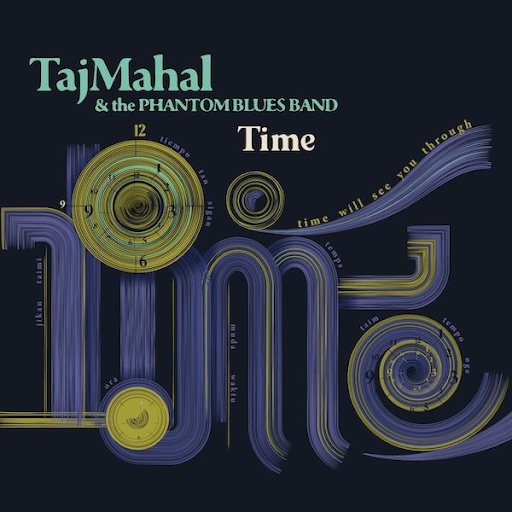
Taj Mahal has spent a lifetime proving that American roots music is not one narrow road, but a wide, winding river. Blues, folk, Caribbean rhythms, soul, jazz, country, and R&B have all moved through his music, not as separate styles but as connected traditions. That spirit is at the heart of Time, a 2026 release from Taj Mahal and the Phantom Blues Band, recorded in 2010 and now finally brought into the light.
The album covers a broad range of sounds — blues, reggae, soul, R&B, and roots music — but it never feels scattered. Instead, Time plays like a conversation among musicians who understand each other deeply. The Phantom Blues Band brings a loose but seasoned feel throughout, with Taj Mahal’s voice, guitar, harmonica, and ukulele leading the way. The result is a collection that moves easily between joy, memory, longing, humor, and hard-earned reflection.
The opener, “Life of Love,” sets the tone with a warm tribute to Mahal’s upbringing, where music was not decoration but the center of life. Jazzy horns and percussion carry the song forward as Mahal sings, “when we all sing together, there’s no trouble we can’t rise above.” It is an inviting start, rooted in the idea that music can hold culture, community, and memory all at once.

From there, Time loosens up. “Wild About My Lovin’” is funky, playful, and full of good-time swagger. It does not take love too seriously, but it knows exactly how to get a knee bouncing. “Crazy About a Jukebox” leans into a sweeter blues feel, led by piano and brass, with lyrical references that call up Jerry Lee Lewis, Etta James, New Orleans, Good Time Charlie, and “Ghost Riders in the Sky.” It is the kind of song that lets the listener close their eyes and wander through a musical history lesson without ever feeling lectured.
The title track, “Time,” is one of the album’s emotional anchors. An unreleased Bill Withers demo, the song slows the pace and gives the band room to breathe. Bluesy guitar lines, soothing horns, and steady percussion frame a message that feels simple but earned: time will see you through. In the context of an album recorded years before its release, that sentiment carries extra weight.
The band brings the tempo back up with “You Put the Whammy on Me,” a punchy, horn-driven track with funky guitar chops and playful backing vocals. Like much of the album, it balances humor and groove without losing musical muscle. “Talkin’ Blues,” a Bob Marley cover featuring Ziggy Marley, introduces reggae into the record in a way that feels natural rather than forced. The performance fuses reggae and Southern American blues beautifully, showing just how connected these musical languages can be when handled with care.
“Sweet Lorene,” a modern take on a 1965 Otis Redding tune, gives Mahal and the Phantom Blues Band a chance to dig into classic blues and soul territory. It feels like the kind of song that belongs on a blues record — direct, heartfelt, and fully lived in. But the album’s deepest moment may be “Ask Me ’Bout Nothing (But the Blues),” which carries a more melancholic weight. The song explores the fighting spirit that the blues gives voice to, touching familiar themes without relying on easy tropes. It is the first track on the album that really pulls the listener below the surface.
“It’s Your Voodoo Working,” a cover of the 1961 Charles Sheffield pop/R&B track, brings back the funk with a horn-heavy arrangement and an irresistible tempo. The song circles around attraction, desire, and distraction, and it is hard not to move along with it. The album closes with “Rowdy Blues,” featuring Taj Mahal on ukulele in tribute to Mississippi bluesman Kid Bailey. The song’s folksy, acoustic feel makes it an appropriate closer, bringing the album back toward traditional blues and themes of loyalty, camaraderie, and musical lineage.

As a collection, Time offers nearly everything one could want from a genre-spanning blues and roots album. It is fun, reflective, funky, sad, loose, and deeply musical. Some songs invite movement, others ask for stillness, but the album works because Taj Mahal and the Phantom Blues Band never treat these styles as museum pieces. They play them as living music.
The Phantom Blues Band features Taj Mahal on vocals, guitar, harmonica, and ukulele; Tony Braunagel on drums and production; Larry Fulcher on bass and production; Johnny Lee Schell on guitar, engineering, and production; John Cleary on piano; Mick Weaver on organ; Joe Sublett on tenor saxophone; and Les Lovitt on trumpet, with Ziggy Marley guesting on vocals.
Time may have been recorded in 2010, but its release feels right on schedule. It is another reminder that Taj Mahal’s music has always existed outside of trends. He does not chase roots music; he carries it, expands it, and lets it breathe.