Article Contributed by Gratefulweb
Published on 2026-10-26
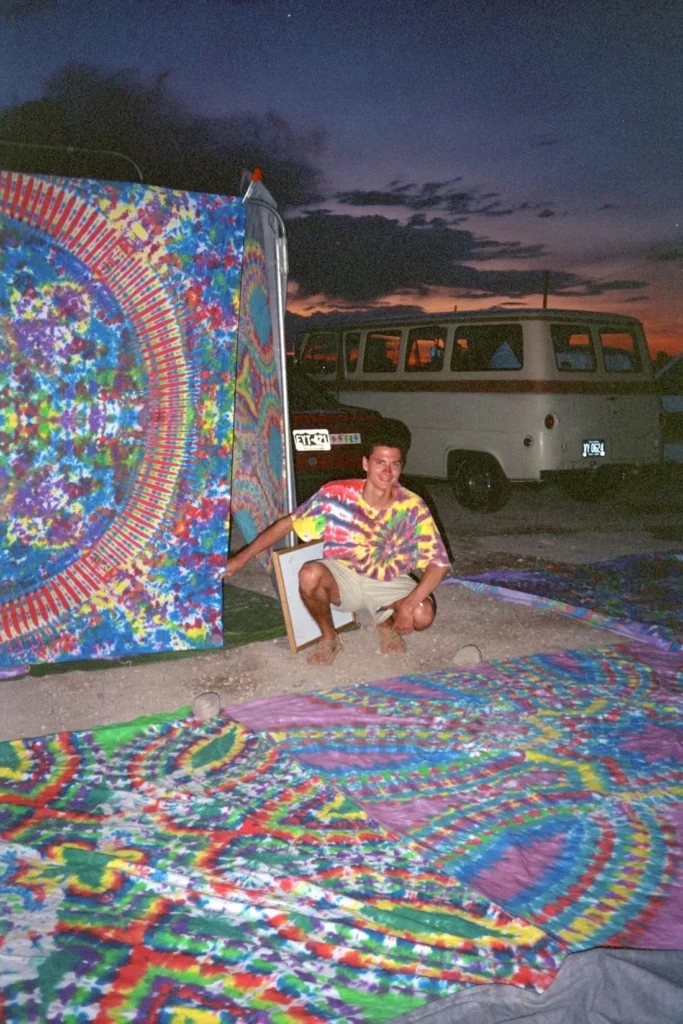
Las Vegas, NV | May 1993 - Images courtesy of Mike Fowler / Art of Tie-Dye.
For Mike Fowler, tie-dye began with his sister, a few large pieces of fabric, and the parking lots outside Grateful Dead shows. In the early 1990s, their tapestries became both a creative outlet and a way to connect with the traveling community around the band. One surviving photograph captures Fowler with their work at the May 1993 Las Vegas shows with Sting—a run that Grateful Web’s Mike and Aaron also attended.
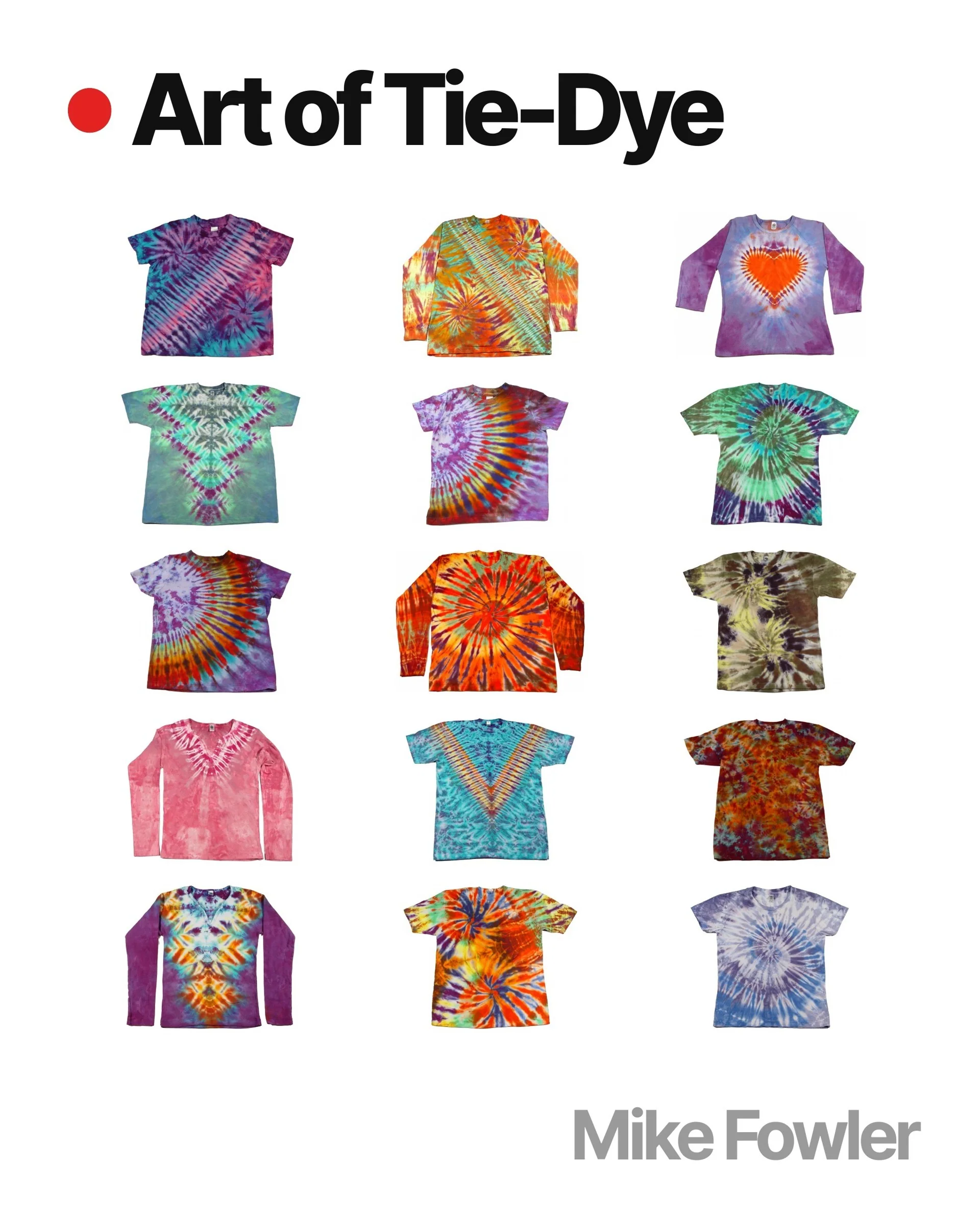
Those early experiments eventually led to Tie-Dyed.com, The Art of Tie-Dye instructional DVD in 2004, and now Art of Tie-Dye: Complete Guide to Folding, Tying, and Dyeing. The 124-page, full-color book covers 11 techniques, pairing illustrated instructions with QR codes linking to video lessons. In our email conversation, Fowler looks back on the Dead lot, the early internet, and the satisfaction of trying something new without knowing exactly what will emerge when the fabric unfolds.
GW: How did you and your sister first get into tie-dye, and what made you decide to start selling tapestries at Grateful Dead shows?
My sister and I started dyeing tapestries together in the early 1990s. We were already going to shows, and tie-dye was everywhere in the lots. Tapestries felt like a bigger canvas than a T-shirt. Selling them at shows was the natural next step and we could have a booth style canopy in the lot and would also walk alongside exiting cars grabbing a ton of attention. It put our work straight in front of the people who loved it most.
After the Vegas shows in '93, I was back in school at Cal Poly in San Luis Obispo. I was lucky enough to have mainframe access and was an active participant in the rec.music.gdead usenet newsgroup. Another user at Symantec offered to scan in photos of my tapestries and we had them on Symantec servers for a few years before the web browser came about. At that time, selling online wasn't a thing as wasn't even legal!
GW: What do you remember about those Las Vegas shows in May 1993? We'd especially love to hear the story behind that photograph.
The Vegas run in May 1993, the shows with Sting, is one I still think about. I remember Sting not fairing so well with the audience until he started doing Purple Haze. I was on the floor one of the days and it was super hot and very tribal. Many people had instruments and those that didn't had objects. It was a show within a show!
The photo is me in the parking lot with our tapestries hung up behind me. It's one of the few photos I have from those years, and it's the reason the book exists in a way. Those tapestries are where I learned most of what's in it. I started with fabric long before t-shirts.
GW: What did you learn from making and selling work on tour, from fellow artists, customers, or simply figuring things out along the way?
I don't think I've experienced anything like that anywhere else- ever. Even Burning Man. Maybe dead shows were a precursor to the man?
I started listening to the Dead back in high school with the Dylan/Dead shows. So selling tie-dye was always secondary. Lucky we never needed tickets as there was always a trade to happen. There was always a couple of us, so we'd take turns going to shows. If it was just my sister and I, we would close up shop and go the show! We could sell out in the parking lot exit line up so it wasn't an issue. Sometimes we'd just hang in the lot as that was also fun! I think tie-dye was more a conduit than the thing.
I probably learned more about bad veggie burritos.
GW: How has your approach to tie-dye changed since those early tapestries? Are there techniques or ideas you still return to?
The chemistry is where I've changed most. Early on, a lot of it was guesswork. Now I'm careful about the basics: scouring the fabric, soaking in soda ash, mixing dye into chemical water rather than plain water, and giving it proper time to cure. That's what makes the colors bright and permanent. The folds I come back to are the same ones I was doing in the lots: the spiral, the mandala and the kaleidoscope. They never get old, and there's always another variation to try.
I've grown in that I can do a wash of color without the need of a defined structure, object or shape. Mandalas are the exception. I think back in the day what I did had a style and method and it influenced hobbyists and tie-dyers across the world (when I released "The Art of Tie-Dye" DVD). The problem with tie-dye as in many craft and art forms is that you get hung up on something that sells, a color pattern that works and stay in the familiar. Becuase I don't have any dependence on tie-dye as a business, I don't have that at all. I prefer trying new things every time. Chasing a new reveal.
GW: What prompted you to make the book now, and how did teaching through a book compare with making The Art of Tie-Dye DVD?
Partially, AI answers. If I made a website, Google would swallow it up and serve it to readers without the source. That's an issue for open forums and info sites like we had in the 90s and 00s.
Realistically though, more than anything, nostalgia! I'm getting old and not far from retirement. So I've been working on a bunch of content.
After Tie-Dyed.com (defunct now) and the DVD in 2004, people kept asking for something they could keep on a table while they worked. Video is great for seeing the movement of a fold, but a book lets you slow down, see every step drawn out, and come back to it. So I did both: Art of Tie-Dye has 124 full-color pages and 11 techniques, and QR codes link each technique to its video lesson. It's the whole method in one place, from your first spiral to a sixteen-petal mandala.
It also allowed me to put all this content that I have out there. From folding illustrations to the DVDs video clips. Putting it out there.
It was just a start as I've had a massive career across printing and the arts having ventured into screen printing. I've been able to make a mark across traditional screen printing, heat transfer printing, t-shirt design, personalization, and even blanks and promotional product industries. So I suspect there will be more books and content put out there before I retire.
GW: For someone who has admired tie-dye for years but never tried it, what's a good first project, and what's one mistake you can help them avoid?
Simple! Pick up a tie-dye kit and try a couple spiral and scrunch t-shirts! Forget about trying to do anything more than that.
Start with a spiral on a 100% cotton T-shirt. It's simple, it always looks good, and it teaches you the rhythm every other fold builds on. The mistake I see most is skipping or rushing the soda ash soak (or even using the soda soak method at all - I prefer activated dye which boggles me why it isn't the dominating method!). It's what makes the dye bond to the fabric, and without it the colors wash out. The other one is folding fabric that's too wet. It should be damp, not dripping, or the colors bleed together and you lose the crisp lines.
Also, tie-dye doesn't have to be "putting" colors in. You can "take" them out too. Spiral up a black tee and spray diluted bleach to discharge color.
GW: What do you hope readers take away from the book beyond learning the techniques?
To get off their computers!
While there are reasons to use YouTube and learn that way, there's something wholesome about having a book on the table. You can also copy the illustration for groups, I'm good with that! The videos are all available for free from QR codes in the book so I guess there is an element of 'computer' that's ok!
I hope they get the confidence to experiment. Once you understand why the folds and the chemistry work, you stop following recipes and start making your own designs. Tie-dye has always been about people, from the lots in the 90s to everyone dyeing in their backyard today. If the book gets someone hooked the way my sister and I were, that's the best outcome I could ask for.
There are so many ways to adventure and kids absolutely love tie-dye and seeing what they made!
Learn more about Art of Tie-Dye: Complete Guide to Folding, Tying, and Dyeing at artoftiedye.com.