Article Contributed by Big Feat PR
Published on 2026-06-13
For more than two decades, Elizabeth Cook has operated outside the machinery of mainstream country while staking her claim as one of American music’s most vital storytellers. On her new album Great Television, due August 14 via Thirty Tigers, the Florida-bred singer/songwriter maps the hidden corners of the American experience with both daring self-revelation and fierce curiosity, imbuing every song with her singular balance of soul and sensitivity and unshakable grit.
Her first new project since 2020’s Aftermath, the Nashville-based musician’s eighth studio LP arrives alongside the theatrical release of The Easy Kind — a hybrid documentary/narrative film about her life as an artist fundamentally resistant to conformity, tracing a turbulent journey that began with singing on bar stages with her parents’ band at just four years old. Taken together, Great Television and The Easy Kind reaffirm the extraordinary legacy Cook has forged by following her own vision wherever it leads.
Produced by Shooter Jennings, Tanya Tucker, Turnpike Troubadours, and recorded with Cook’s live band at Sunset Sound in Los Angeles, Great Television marks a commanding new addition to a formidable catalog including triumphs like 2007’s Balls, a major creative breakthrough featuring her Americana Music Awards-nominated, career-defining anthem “Sometimes It Takes Balls to Be a Woman,” 2010’s Welder, made with legendary producer Don Was and selected for Rolling Stone’s list of the year’s best albums, and 2016’s Billboard-charting Exodus of Venus, one of several of Cook’s LPs glowingly reviewed by seminal rock critic Robert Christgau.
In the making of her latest body of work, Cook expanded on the novelistic sensibilities of her past few albums while shaping her songs into exquisitely taut arrangements that hit with immediate impact.
“I wanted this album to take everyone on the ride of the American experience, both from a deeply personal perspective and from a place of reflecting on historical events and their ripple effects,” says Cook. “It felt important to make the songs very concise and digestible, but with a lot of layers to dig into if you want to really dive in. There’s a lot of code in these lyrics.”
Built on a potent collision of country and rock & roll, Great Television takes its title from its luminous opening track “Sunset Promenade” — a perfect introduction to an album that perpetually moves between soul-searching introspection and piercing observation.
From the chorus: “Turns out hurricanes are great television / Turns out all the things in my head are a prison / And I just want a friend I can stand and do my time with.”
In an era when much of modern life is filtered through screens, the LP’s title gestures toward the psychic dangers of media saturation and hints at Cook’s own uneasy relationship with fame, including a 2011 appearance on Late Show with David Letterman that vaulted her into the national spotlight and led to an ill-fated sitcom deal with CBS.
“To me Great Television speaks to how we’re so consumed by media, enriched and manipulated by it at the same time,” she says. “When I look back on the first time I was on the Late Show, it completely changed my world in ways that became a huge distraction from my music. The whole experience made me realize how media can interfere with your life and what you’re meant to do.”
After “Sunset Promenade,” an aching meditation on friendship as salvation from the cruelty of the outside world, Great Television locks into a full-tilt momentum with “Girls of Atomic City,” the first in a series of songs illuminating the type of lives typically sidelined in the dominant media narrative.
“A while back I learned about the women who worked on the Manhattan Project, and it was such a fascinating a-ha moment for me,” says Cook. “People tend to think about the atomic bomb in very black-and-white terms, but for a lot of those women, it opened up a whole new world where they got to leave home for the first time and make their own money. It was such a major cultural shift.”
Another track that unearths the emotional truth buried within long-overlooked histories, “Thiokol Tripwire” embodies a heavy-hearted intensity as Cook recounts the story of a 1971 explosion at a Georgia chemical plant.
“The plant was making tripwires for the Vietnam War, and it was the only place in the area that would hire Black women,” she explains. “It was a very dangerous job, but it gave those women an opportunity in a town that wouldn’t hire them anywhere else, and represented real economic progress for their community. And then when the explosion happened, it was mostly Black women who lost their lives.”
In its radically empathetic honoring of women pushed to the periphery, Great Television moves into more autobiographical terrain on songs like “The Easy Kind” — a slow-burning duet with Wynonna Judd, penned as Cook looked back on a life-altering period of personal tragedy, including the deaths of several family members in quick succession.
“The people around me were concerned about my coping mechanisms and I got shipped off to rehab, which just became another trauma in itself,” she says. “What frustrated me was feeling like my autonomy had been taken away, like I had to prove I was worthy of being trusted with my own life. It can be difficult to be vulnerable and in a position of power at the same time, especially when you’re a woman.”
As the centerpiece to Great Television, and the namesake for the cinematic portrayal of Cook’s life, “The Easy Kind” ultimately arrives as a defiant refusal to smooth out her edges for the sake of appeasing others.
Elsewhere on Great Television, Cook brings her own story into sharper focus. On “Okeechobee Mud,” her lyrics inhabit a Southern Gothic moodiness as she drifts into a tender recollection of the place that raised her, the sleepy Central Florida town of Wildwood.
“That song’s about getting into a relationship almost solely because the other person reminds you of where you’re from,” says Cook, who began writing “Okeechobee Mud” on banjo nearly two decades ago. “Because I’ve lost so much family and it’s been so long since I left the Deep South, I really miss my culture and my home people. I miss the accent, the fried gator tail, the sand roads — all of it.”
One of the album’s most thrilling tracks, “Razorwire Wall” finds Turnpike Troubadours’ Evan Felker joining Cook for a hot-blooded love song inspired by dropping her ex-boyfriend off at jail.
And on “Lightly,” Great Television ends with a gorgeously elegiac outpouring of love that transcends earthly limits.
“I grew up in a volatile household, and I was 11 years younger than the sibling closest to me,” says Cook. “Since I was too small to protect my siblings or even completely understand what was happening, I’ve become really protective over them in my adult life. That song’s about feeling that protectiveness, but it’s also about us finding peace and standing in solidarity with each other.”
All throughout Great Television, Cook reveals her resolute commitment to emotional honesty — an ethos that also forms the beating heart of The Easy Kind.
Directed by award-winning filmmaker Katy Chevigny, and featuring cameos from David Letterman and Susie Essman, the naturalistic but richly drawn feature film merges documentary sequences, scripted scenes, and archival footage of Cook’s parents and her early days as a child performer.
“Katy proposed the idea of having the film be a hybrid, which I thought was genius,” Cook recalls. “It provided me with a protective layer from exposing too much, but allowed me to get my point across and work with actors in a way that was truly creative.”
Spanning from unvarnished vignettes of Cook alone at home, snapping green beans, writing songs in her pink legal pads, to snapshots of her onstage life, including a scene at the Grand Ole Opry, where she’s performed over 400 times without ever being inducted as a member, The Easy Kind includes footage from a solo acoustic performance in which her between-song banter offers up candid details of her life story.
The result is a riveting look at the complicated reality of sustaining an uncompromised artistic life, at turns poignant and colorful and wildly inspiring.
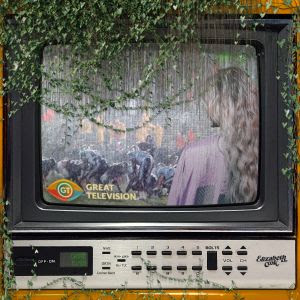
In keeping with the hard-won resilience humming throughout Great Television and The Easy Kind, the cover to Cook’s latest album features a TV set tangled with vines, its screen lit up with a surreal piece of Americana: a painterly photograph of a nationally televised football game at her alma mater of Georgia Southern University in 1989, when the team stormed to victory despite playing in the midst of a Category 4 hurricane.
“To me, that’s great television,” says Cook. “The photograph is a beautiful piece of art on its own — there’s a real spirit of resilience to it. And then because I’m still a swamp witch at the end of the day, we added the vines to bring in a layer of femininity and sensuality.”
Whether excavating forgotten histories or reflecting on her own life, Cook remains devoted to uncovering the humanity beneath the surface of every tale she tells.
“I’m always trying to serve a bigger story than my own,” she says. “But it’s always a thin veil — it’s all autobiographical on some level, or I wouldn’t be driven to do it. For me that’s the best of both worlds: getting to express my truth, while also sharing someone else’s story.”
“The Easy Kind” Premiere and Q&A Dates
June 16 — Athens, GA
June 17 — Atlanta, GA
July 7 — Chicago, IL
July 13 — Dallas, TX
July 14 — Austin, TX
July 15 — Houston, TX
July 21 — Los Angeles, CA
July 23 — Portland, OR
July 25 — Seattle, WA
Upcoming ShowsJune 26 — Nashville, TN — Rhythm & Roots at The Hermitage