Article Contributed by Gratefulweb
Published on 2026-07-19
For two years, Matt Myers struggled to finish new songs.
“I was all raw emotion,” says the Houndmouth frontman, who had spent the previous decade blending rock & roll and American roots music into radio staples such as the chart-topping, platinum-selling “Sedona.” He had written four albums in less than 10 years, but inspiration just was not showing up anymore.
“I was feeling so much that I just couldn’t write anything,” he adds.
The end of one relationship. The beginning of another. The all-consuming feeling of new love. Myers’ life had been eventful, both onstage and off, and all that living did not leave him much time to create.
Things changed when he paid a visit to Brad Cook, the Grammy-winning producer who had overseen Houndmouth’s fourth record, Good For You. What began as a reunion between two friends soon gave way to something bigger: the restart of Myers’ songwriting engines and, in its wake, the creation of Lordy.
With its naked honesty and uncluttered arrangements, Lordy takes a stripped-back approach to Houndmouth’s ever-evolving sound. It is an album about surviving, rebuilding, accepting and thriving once more.
Myers wrote most of the record’s songs at home, strumming his Martin guitar while sunshine streamed through the kitchen windows. Years ago, he might have composed the record at night, tossing back a few drinks for encouragement. This was different.
Clear-headed and wide awake, Myers reclaimed his muse during the daytime hours, beginning with songs such as “Tiger Blood”—a ragged folk-rocker that builds toward a screaming finish—and the album’s intimate title track.
“I let unfiltered emotion inform the words,” he says. “With several songs, I learned to be OK with just letting some syllables line up, and letting the emotion behind it all do the talking.”
This marked a change from the band’s early days. Back then, Myers and company agonized over the precise placement of every snare hit and vocal harmony on albums such as Little Neon Limelight, Houndmouth’s commercial breakthrough.
Steeped in the influence of 1970s roots-rock, those early records were collaborative efforts that merged Myers’ vision—as a songwriter, vocalist and fiery lead guitarist—with the input of his three bandmates.
“I needed those albums to be collaborative projects because I was scared of being completely in charge,” he admits. “Maybe that stunted me. This is the first time I’ve been able to write a record completely on my own, and there’s a pressure that comes with that. I had to relearn everything.”
Recording sessions were scattered throughout a year, but Lordy still came together quickly. Myers would record a one-take performance of each song on his acoustic guitar, then build it into something bigger with help from other musicians.
He told himself not to get lost in the mechanics or minutiae. The goal was not to be perfect. It was to capture a moment, allowing the thoughts swirling inside Myers’ head to find the quickest route into his music.
Cook played an integral role in the creation of Lordy, not only as a producer but also as a close friend and confidant.
“When I visited him in North Carolina for the first time, he walked out of his garage and gave me a big bear hug,” Myers says. “He told me he was happy for me, and he gave me a lot of confidence with my new songs.”
Cook also reached out to others, surrounding Myers with a small circle of musicians who, like him, blurred the lines between modern indie music and the old-school roots of Americana.
Iron & Wine’s Sam Beam stopped by the studio during the creation of the album’s final track, “Holy Moses,” to offer advice and encouragement. MJ Lenderman also paid a visit, adding his trademark guitar licks—loose, lo-fi and full of life—to multiple tracks.
Phil Cook of Megafaun and Hiss Golden Messenger played on several songs, as did Houndmouth keyboardist Caleb Hickman. Hickman and his wife, Kay Robertson, also contributed to the songwriting process.
“I’ve spent years working with peers and contemporaries,” Myers says, “but this felt different. I was surrounded by people who were literally trying to pick me up and help me out. They pushed me to do the work.”
Between recording sessions, Myers returned to Louisville to rehearse the songs with his bandmates in a warehouse basement. Something about the basement’s gritty, frills-free atmosphere—utterly unlike the restored 19th-century house that had served as the band’s headquarters for years—seemed to suit the new music.
Steadily, the songs came together. “Heavy Eyes” explored the intersection of fatigue and hope, building toward a cinematic finish. “Don’t Wanna Talk About” moved between scaled-back verses and singalong choruses. “Never Gonna Die” turned simplicity into beauty, with Myers singing about challenging relationships over an uncluttered mix of hooks, harmonies and groove.
Lordy asks its audience to lean in, listen closely and engage, kickstarting a new era for Houndmouth.
From Golden Age’s embrace of shimmering electronics to Good For You’s return-to-form focus on American roots music, Houndmouth has spent years evolving, unafraid to examine new sounds and different perspectives.
Lordy continues that exploration. Although it may be the most intimate record in the band’s catalog, it still packs an emotional punch that lingers long after the music fades.
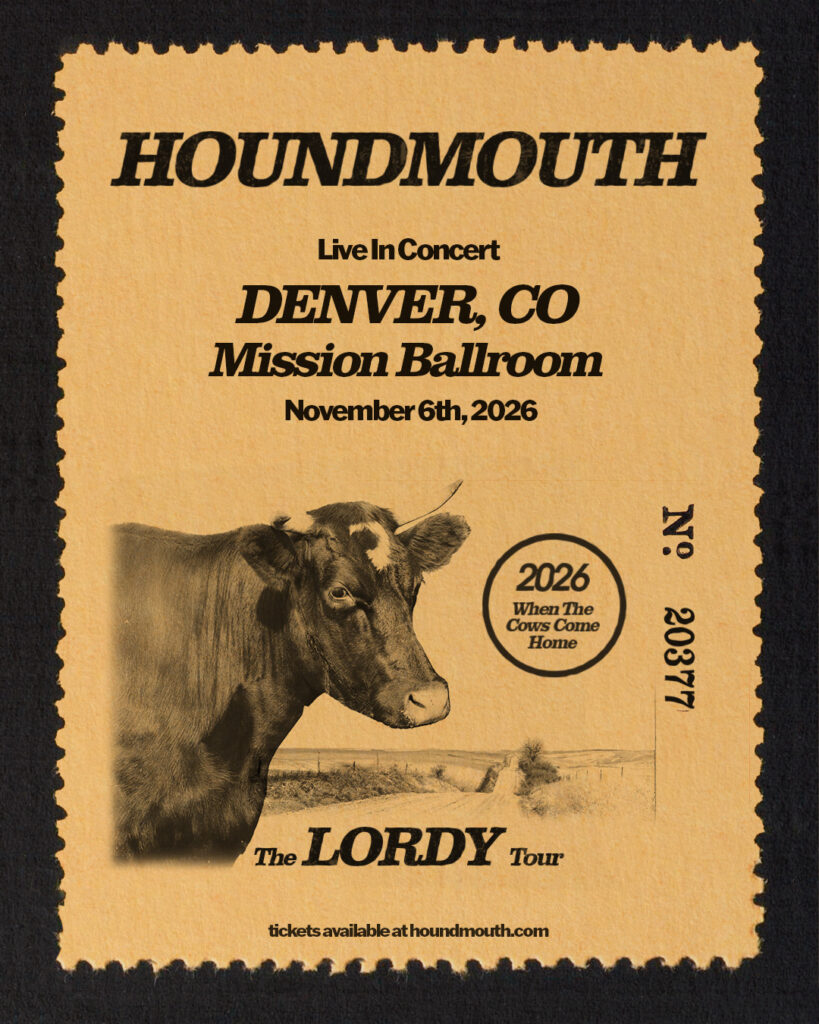
Houndmouth
Friday, November 6, 2026
Mission Ballroom
4242 Wynkoop St.
Denver, CO 80216
Tickets on sale:
Friday, July 24, at 10 a.m. MT
Tickets may also be purchased at the Mission Ballroom box office with a $2.50 flat fee. The Mission Ballroom box office is open Monday through Saturday from 10 a.m. to 6 p.m.